You may have landed here through AI or an organic web search. Either way, I presume you are not just looking for data engineering best practices, but focused on ensuring that your organization’s cloud data platform doesn’t go wasted as if it is often for one thirds of businesses. Initial success is common, but after two years, most cloud data platforms go unused or underused.
So, why do cloud data platforms fail after 2 years?
The reasons for failures often differ according to an organization’s scale and stage of maturity. A startup is in dearth of quality data to feed its AI models, but in the rush to move quickly, it falls into the trap of data engineering technical debt.
On the other hand, an enterprise imposes strict governance controls, but forgoes the speed that its individual business units desire. Is it possible to achieve speed and quality at the same time? Is it possible to move quickly without creating technical debt, compromising data quality or making their data systems harder to maintain?
That brings us to the end goal these data engineering best practices should collectively deliver. We call it the holy grail of data engineering: Sustainable speed.
The Goal: Sustainable Speed
What is sustainable speed in data engineering?
Sustainable speed is the ability to give teams fast access to trusted, unified and governed data without creating technical debt, compromising data quality or encouraging shadow engineering. It accelerates an organization’s time to market without making its data systems slower, costlier or harder to maintain tomorrow.
The speed-versus-quality framework below illustrates this distinction
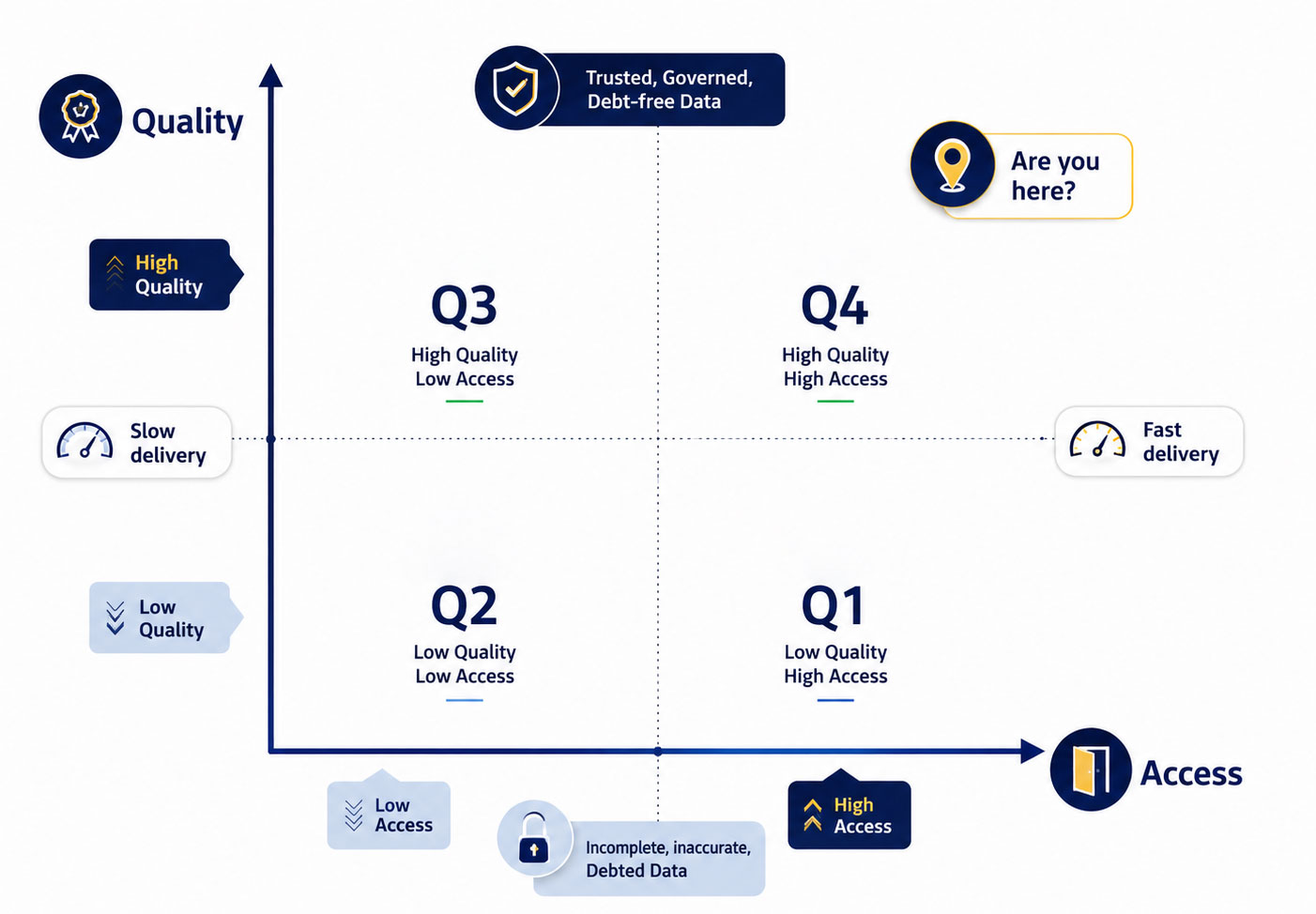
You may have looked at the graph and wondered what could take your company to move into Quadrant 4 fast access and high quality.
It is certainly an enviable position because organizations in this quadrant demonstrate not just fast data delivery, but also the ability to consume trusted, governed, unified and debt-free data.
But is it that simple to reach Quadrant 4?
Even if a startup has instant access to high-quality data, it may sometimes be forced to take shortcuts that inadvertently push it towards Quadrant 1 fast access but poor quality.
At the other end of the spectrum, an enterprise may establish strong governance and centralized control but struggle to deliver data at the speed required by business teams. It may begin in Quadrant 3—high quality but slow access only to slip towards Quadrant 2 when frustrated departments create disconnected workarounds.
Six Best Practices for building database to dashboards pipelines
The following six practices can help organizations move towards – or remain in – the top quadrants.
1 Reduce Technical Debt in Data Pipelines
One of our SaaS clients had developed a proprietary ML model to predict client attrition, but its in-house data science team lacked MLOps resources.
The model ran on a local laptop. Every time, someone had to export its predictions as a CSV file, upload it to the cloud and manually execute an SQL script to feed the database.
This approach continued for a year until it began consuming valuable engineering time. It is a classic instance of data engineering technical debt.
Trigent migrated the model to the cloud and automated the entire SQL workflow. This data pipeline automation eliminated a repetitive manual process and prevented a temporary workaround from becoming a permanent operational burden.
How do you prevent Data engineering technical debt? The answer lies in documentation, periodic assessments and proactive remediation as soon as it appears. Temporary pipelines and hardcoded or duplicated logic become dangerous when nobody remembers they were temporary. Eliminating such debt early protects data quality.
2 Stop Shadow Data Engineering in Enterprises
Let’s move to the other end of the spectrum. A large enterprise with limited data maturity decides to become data-driven. It hires a head of data to declutter messy data and formalize enterprise analytics through a centralized data platform architecture.
The enterprise adopts an integrated cloud data platform covering ingestion, modelling, data integration, data governance, data observability and performance optimization. Managed by the IT team, the platform takes care of governance and compliance requirements while providing an optimal user experience.
The enterprise is now comfortably positioned in Quadrant 3—high quality but slow access. However, the centralized approach begins to conflict with the time-to-market requirements of business stakeholders. Different business units depend on the IT team’s timelines, creating frustration and encouraging workarounds.
Departments begin bypassing standard procedures and adopting their preferred tools, including Power BI, SAP BusinessObjects and Excel. At first, this accelerates reporting. But before long, each tool expands into a separate data environment, leading to shadow data engineering.
Budgets rise, tools stop communicating with one another and enterprise KPIs are defined inconsistently across departments. As conflicting numbers spread across the organization, data quality becomes a boardroom concern. Troubleshooting no longer takes hours but days, while maintenance costs skyrocket.
The enterprise has now slipped into Quadrant 2—poor data quality and slow access. The problem was not data governance itself, but a centralized delivery model that encouraged business teams to operate outside it.
3 Combine Data Pipeline Automation with Data Observability and Data Lineage
Data pipeline Automation must be supported by data observability. Teams should instantly know when a pipeline fails, when data arrives late, when a schema changes and when outputs fall outside expected thresholds. Without data observability, an automated pipeline can continue delivering incorrect information at great speed.
If data observability gives you visibility in your pipeline failure and schema changes, Data lineage provides the necessary context as to why it could have happened.
When a metric changes unexpectedly, teams with automated data lineage will be able to trace it through transformations, pipelines and source systems. Automated data lineage also reveals which dashboards, AI models and business processes a change will affect.
Together, automation, data observability and data lineage reduce troubleshooting time. They also strengthen data integration by making information movement visible across systems.
4 Combine Data Governance with Self-Service
The problem in the enterprise story was not data governance itself. The problem was governance implemented as a centralized delivery bottleneck.
Organizations should embed data governance into engineering workflows through access controls, clearly defined ownership, policy enforcement, audit trails and automated lineage. Effective data governance should make trusted data easier to access, not force every business question into a long IT queue.
Business teams also need governed self-service. Shared definitions, semantic models and role-based access let departments build reports without creating conflicting KPIs, while supporting faster data integration.
Governance and self-service should therefore operate together. Governance establishes the boundaries of trust; self-service gives teams the freedom to move within them.
5 Combine Scalability with Portability
A sound data platform architecture should address current needs without losing sight of growing data volumes, workloads, users and use cases.
Strong data platform scalability requires modular components, reusable pipelines and clear interfaces. But scalability should not lock the organization permanently into one platform.
The data platform architecture should remain technology-agnostic wherever practical. Open standards, portable code and business logic separated from platform-specific functionality make future migrations less disruptive and reduce vendor dependency.
These data platform best practices allow organizations to take advantage of Databricks, Snowflake or Microsoft Fabric without surrendering control over their data and business rules. They also support data platform scalability by making it easier to add sources, workloads and users incrementally.
Sustainable Speed Requires All Six Practices
These five data engineering best practices work as a connected system. Speed without quality creates technical debt, while quality without speed encourages shadow engineering. Automation without observability accelerates failure; governance without self-service creates workarounds; and scalability without portability deepens platform lock-in. Together, these imbalances compromise trust and prevent sustainable speed.
At Trigent, we combine maintainable data platform best practices with technology-independent standardization to help organizations accelerate access to trusted data without creating tomorrow’s technical debt. That is the essence of sustainable speed.
| Talk to Our Data Engineering Experts Today |