Walking into the Javits Center for the ninth annual AI Summit in New York was like stepping into the future of Artificial Intelligence. The energy was palpable, the buzz of conversations electric, and the sheer scale of innovation on display was awe-inspiring.
The AI Summit was a glimpse into the transformative power of generative AI services and its growing and progressively dominant role across industries.
As I navigated the hallways, the diversity of attendees became immediately apparent. According to the organizers, over 5,000 participants from 47 countries had gathered – from C-suite executives and tech leaders to policymakers and AI enthusiasts. The shared goal? To exchange ideas and initiatives that move AI from experimentation to impactful, scalable solutions that drive real-world value.
The summit kicked off with a keynote address from New York Governor, Kathy Hochul. Her announcement of the ambitious “Empire AI” initiative – a $400 million, 10-year investment in AI and generative AI services for public good – set the tone for the event. It was a powerful reminder of the responsibility that comes with advancing AI technologies and harnessing their potential for societal benefit whilst navigating the ethical challenges.
With great power comes great responsibility. AI is an extremely powerful technology, and experts pushing for its responsible use is increasingly gaining momentum.
AI for Tangible Business Impact
One of the recurring themes throughout the summit was the alignment of AI initiatives with business objectives and commercial AI coming to life.
In session after session, industry leaders emphasized the importance of demonstrating tangible ROI on AI investments. The message was pretty clear: AI and generative AI services are no longer just a playground for experimentation; it’s a strategic imperative for enterprises aiming to stay competitive.
Exploring Cutting-Edge AI Technologies at the AI Summit
Among the many captivating sessions, a few stood out for their depth and relevance. Discussions on the future of multimodal models—capable of processing text, images, and other data types simultaneously—were particularly engaging. Experts explained that these models are set to redefine the boundaries of generative AI services and its capabilities, paving the way for more holistic and human-like decision-making processes.
Several sessions delved into the advancements and applications of multimodal AI models. One notable session, “The Game Changer: How Multimodal AI, Biocomputing, and Silicon Innovations are Shaping the Future of Gaming and Interactive Storytelling,” explored the convergence of generative AI services and other technologies in revolutionizing the gaming industry. Experts discussed platforms like NVIDIA Omniverse and tools such as Promethean AI, highlighting their roles in automating content creation and transforming non-playable characters into dynamic, adaptive entities.
How Generative AI Services Are Transforming Industries
Another highlight was the focus on generative AI services, which is poised to transform industries ranging from healthcare to finance. Many expert panels explored its application in areas like drug discovery, creative content generation, and customer engagement. The potential for generative AI to automate complex processes while fostering innovation was a recurring point of shared excitement.
Immersive Exhibits and Practical Use Cases
The exhibition floor was a hive of activity, showcasing cutting-edge solutions from AI startups and tech giants alike. I had the chance to interact with experts at some fascinating demonstrations—from AI-driven supply chain optimizations to real-time natural language processing applications created using top-of-the-line generative AI services. It was inspiring to see so many practical use cases of AI being actively deployed in industries like manufacturing, retail, and logistics.
The exhibition floor was a vibrant showcase of innovation, featuring a diverse array of AI-driven solutions from both emerging startups and established tech leaders. A standout attraction was the AI Playground, an interactive zone where attendees engaged with live demonstrations and hands-on activities, experiencing firsthand how AI is transforming various industries.
One of the most popular exhibits was the GDC Zone, a collaboration between the Game Developers Conference (GDC) and The AI Summit New York. This area highlighted the integration of AI and generative AI services in game development, featuring cutting-edge technologies that are reshaping interactive entertainment.
Ethics and Governance in AI
Ethics and governance were also front and center. In one session, a panel of experts delved into the challenges of ensuring responsible AI deployment. Topics like bias mitigation, transparency, and regulatory compliance sparked thoughtful discussions, underscoring the need for robust frameworks to guide AI’s evolution.
Networking and Building Connections
Networking was another highlight of the event. Whether during coffee breaks or at dedicated networking sessions, the opportunity to connect with like-minded professionals and exchange ideas was invaluable. I found myself in conversations about everything from scaling AI infrastructure to integrating AI with legacy systems—topics that are not only timely but critical for successful AI adoption. A Closer Look at Trigent AI Studio for Generative AI
Trigent’s AI Studio attracted a lot of interest from customers and partners alike. Designed to address critical industry pain points, this platform empowers enterprises to build secure, enterprise-grade AI applications with unparalleled ease. In an era where data breaches and security concerns dominate headlines, Trigent AI Studio operates as a digital Faraday Cage, ensuring military-grade security and robust data confidentiality through an isolated, air-gapped low-code platform.
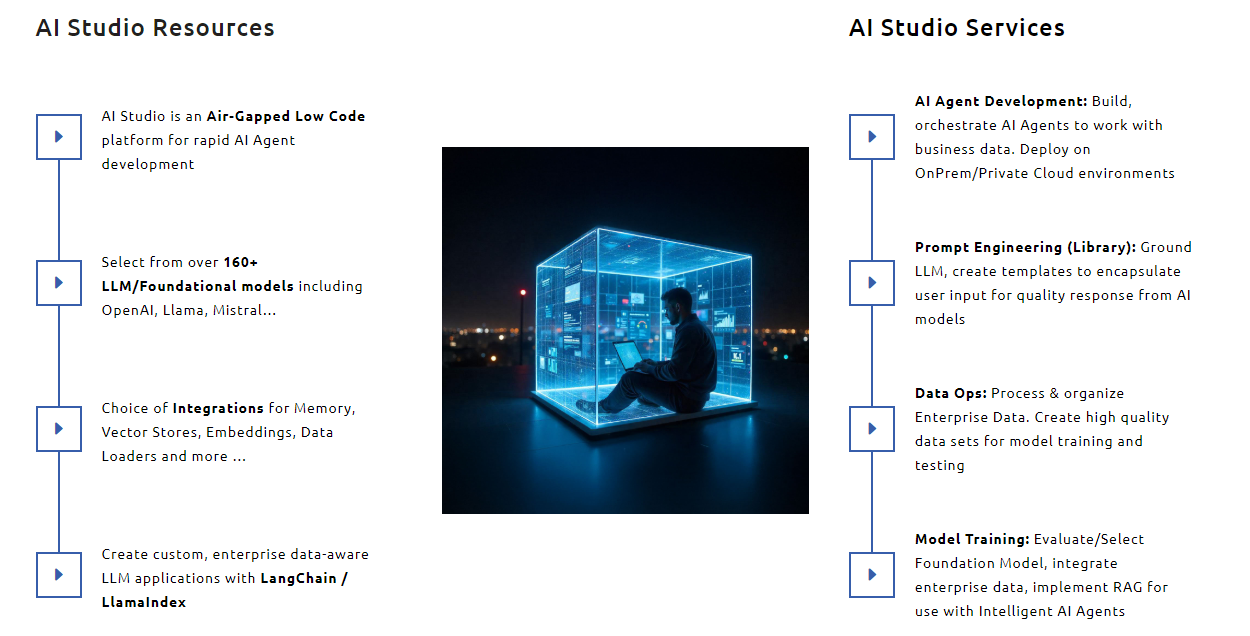
Industries today face significant challenges in integrating AI into their operations—from safeguarding proprietary data to navigating complex compliance landscapes. Trigent AI Studio tackles these challenges head-on, providing seamless integration with over 160 foundation, pre-trained, and large language models (LLMs). This flexibility allows businesses to harness AI’s power while customizing solutions to their unique needs, driving faster time-to-market and scalability.
What makes Trigent AI Studio truly transformative is its ability to democratize AI adoption. By simplifying the development of generative AI agents and applications, the platform enables enterprises to unlock the full potential of their data. Whether it’s automating workflows or enhancing customer interactions, Trigent AI Studio exemplifies how secure and efficient AI can drive meaningful change.
Commercial AI Comes to Life
One of the event’s most compelling themes was “Commercial AI Comes to Life,” reflecting the tangible ways AI is reshaping industries. The summit brought this theme to life through a variety of sessions and exhibits that showcased real-world AI applications delivering measurable impact.
From predictive analytics in supply chains to AI-powered personalization in retail, the emphasis was on translating cutting-edge research into practical solutions. Panel discussions explored how enterprises are leveraging AI to improve operational efficiency, reduce costs, and create new revenue streams. It was a powerful reminder of the fact that AI is no longer confined to theoretical discussions—it is an enabler of commercial success.
What truly stood out was the focus on scalability. Speakers highlighted the need for robust infrastructure and strategic alignment to ensure that AI solutions can grow alongside business needs. The message was clear: commercial AI is not just about innovation; it’s about making AI an integral part of business strategy to drive long-term value.
Reflections and Future Directions
By the time the summit concluded, I was both exhilarated and deeply contemplative. The AI Summit New York wasn’t just an event; it was a call to action for everyone in the AI ecosystem. The discussions, innovations, and connections formed over those two days left me with a renewed sense of purpose and an arsenal of insights to bring back to my work.
As I left the Javits Center, I couldn’t help but feel optimistic about the future of AI. The summit proved that while challenges remain, the collaborative spirit of this community is more than capable of addressing them. AI is no longer the technology of tomorrow—it’s the transformative force of today, shaping industries and redefining possibilities in ways we’re only beginning to understand.