In our previous blog, we highlighted the critical role played by the Enterprise orchestration layer when you deploy custom Gen AI applications. The enterprise orchestration layer not only serves as the vital nexus between your Gen AI infused business applications and foundational LLM models, it offers the flexibility to update the underlying LLM independent of the application or switch to a different model if required. In the fast evolving Generative AI industry, this eliminates the risk of lock-in and freedom to use the best-in-class tech.
In this blog post, let’s dig deeper to uncover the individual components that constitute the enterprise orchestration layer as it applies to Generative AI architectures. Understanding these individual components is crucial to ensure that your IT infrastructure is truly Gen AI ready.
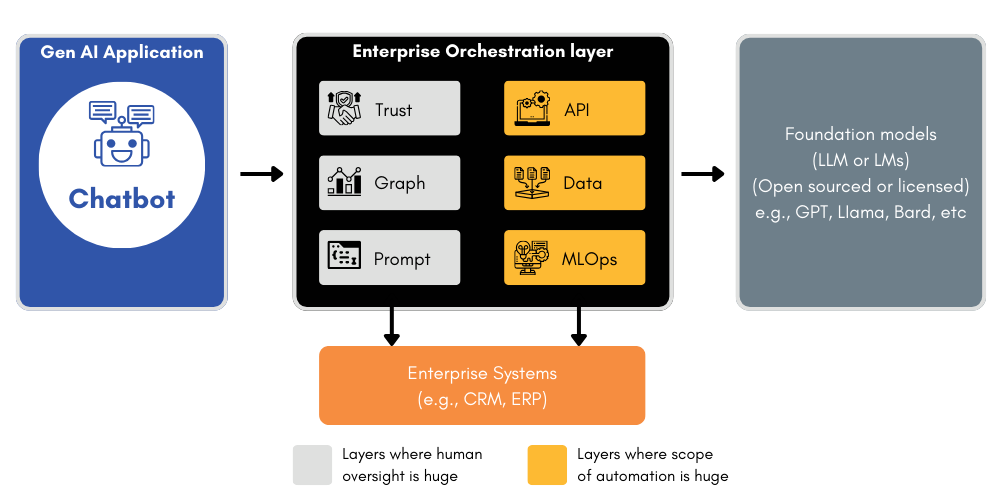
The Components of Enterprise Orchestration layer – Explained
1 Prompt layer
In a basic GenAI application, users input a query and receive a human-like response from a pre-trained model. However, these responses are not aligned with specific organizational needs. This is because generic models lack the awareness, context and data of the enterprise and its operational needs. So, to make it enterprise-specific, the response should be based on enterprise data. This is where system prompting and Retrieval Augmented Generation (RAG) assume significance.
(i) System prompting: It typically grounds the foundational model interactions in three areas.
- What are you? (E.g., you are a chatbot, and your name is Tony)
- What is expected of you and what are your boundaries? (E.g., you don’t need to discuss life or death)
- How do you process queries? (E.g., think step by step).
(ii) Retrieval Augmented Generation (RAG)
Now that you have instructed the system how to behave, it still lacks the enterprise-wide context. This context is possible only if the pre-trained foundation model is enabled to reference your enterprise data. The RAG framework facilitates the above mechanism through two functions:
- It retrieves the enterprise data related to the user prompt.
- Upon which, the foundational model augments a suitable response considering the user prompt, system prompt, and retrieved enterprise data.

Note: RAG framework leverages an enterprise knowledge base to supplement the model responses. However, you can directly infuse your domain and enterprise-specific datasets into the pretrained model. This is what we call fine-tuning, which can be done through essentially four methods:
- Supervised fine-tuning – where you fine-tune the model with a large labeled dataset.
- Few-shot fine-tuning – Where you fine-tune the model with few prompts (ideally suitable when the data is scarce).
- Transfer learning – where you allow the model to perform a task different from the task it was trained on.
- Domain-specific fine-tuning – where you tailor the model to a specific domain.
2 Graph layer
Remember how RAG would retrieve data using the enterprise knowledge base. This knowledge base is structured in a logical way, enabling RAG to dynamically access and analyze inherent connections between the entities stored in the graph. The graphs are intended to capture nuanced meanings between objects through a structured representation. Ultimately it gives more contextual grounding for RAG models. The following are the objects of the graph layer.
- Nodes are the primary elements in the graph representing a unique entity such as a person, place or any entity.
- Edges are the lines between these nodes, describing the relationships between the nodes.
- Properties provide additional information between nodes and edges.
3 Data layer
The highly contextualized answers generated by the fine-tuned model are dependent on the data semantically arranged by the knowledge graph. But what if the data is inaccurate or incomplete? This is where the data layer assumes significance.
Three components form the data layer:
Data sources: The myriad data sources that come from your business management systems like ERP or CRM; real-time data from sensors monitoring physical equipment, and the data from emails, support tickets, and so on.
Data pipelines: The overall goal of data pipelines is simple: they move the data from source (databases, APIs, or files) to destination (lakes, warehouses) transforming the data either along the way or at the destination. In GenAI, applications will tap into the unstructured data from documents, images and videos. It should be noted that the unstructured data cannot fit into relational databases. Hence they are transformed by chunking, extracting, and embedding before finally being stored into vector databases.
Storage:
- Traditionally, structured data is stored in data warehouses for efficient querying and analysis.
- Data lakes offer a more flexible way to store structured and unstructured data.
- The Lakehouse Architecture combined the best of both worlds, providing structure and query capabilities on top of a data lake.
- Vector embeddings are a popular method for representing unstructured data for similarity search and AI applications.
4 MLOps
MLOps are the set of frameworks and collaborative processes, which enables data scientists and IT operations to come together, ensuring consistent development and deployment of fine-tuned LLM models.
While computer and data scientists involve themselves in developing the model, IT operation teams focus on deploying, managing and maintaining the customized LLM model for business use.
We have to remember that the above layers (Prompt, Graph, and Data) are used at the run-time. They form the basis for real-time interaction with the gen AI model. On the other hand, MLOps is concerned with improving the models in parallel, pushing them into production for run-time use.
MLOps entails three core functions:
- Automated model training: It trains the ML models with preprocessed data, using different hyperparameter tuning. The objective is to arrive at the best performing model version.
- Model monitoring: The system evaluates prediction accuracy, reduces prediction mistakes, and alerts users based on model or data drift so that proactive action may be taken as soon as the model breaks the underlying assumptions.
- Model governance: Components include reproducibility and validation;. observation, visibility and control; monitoring and alerting; security; conformity and auditability.
5 API Layer
The core function of the API management layer is to facilitate seamless and secure data exchange and interactions between enterprise systems, the Gen AI applications, and the underlying LLMs.
- API security: Features such as authentication, authorization, rate-limiting, IP filtering, and data encryption help prevent data breaches.
- API scalability: API comes with the ability to handle multiple requests simultaneously.
- Frictionless integration: Support for diverse data formats and facilitating real-time data streaming.
- Model management: Allows for seamless switching between different LLM models.
- Error handling: Provides comprehensive error reporting and logging capabilities.
6 Trust layer
The outcome of the trust layer is to create Responsible AI that is accurate, reliable and free of bias. To achieve responsible AI, companies must adhere to highest data quality and governance, instill robust data security controls, establish guardrails and human-in-the-loop validation, all of which permeate across the above-mentioned layers.
Ultimately, the data generated by Responsible AI must meet the five criteria:
- Explainability (ability of the model to explain how it arrived at a decision)
- Accountability (regular audits to proactively identify and eliminate errors)
- Security (making sure the data doesn’t seep out into the world – e.g., through the internet and other medium)
- Bias-free (ensure that the input data is gathered from diverse sources and not from narrow sources that could contain inherent bias).
- Enrichment – when input data is constantly supplied with rules and tags specific to company policies.
The Real Challenge
The real challenge lies in orchestrating these individual components of the enterprise layer to enable it to perform as one unified whole. These individual components must fit together to perform as one unified enterprise orchestration engine.
Get the Trigent Advantage in Creating Unified Enterprise Orchestration Engine
With 30 years of expertise in end-to-end software services delivery, Trigent is already at the forefront, building AI applications. Our consulting and solutions expertise help organizations build ethical, perceptive, and responsible Gen AI applications. The range of tools we use at every layer helps you achieve a robust technical foundation on top of which you can build Gen AI-powered applications, bound to deliver humongous business value.
Talk to Trigent’s GenAI experts