For many years now, enterprises have been battling an invisible yet costly adversary – data chaos.
As businesses scale and adopt multi-cloud architectures, AI-driven analytics, and real-time data processing, governance complexities skyrocket. Data silos, security risks, and compliance challenges make it nearly impossible to maintain trust and efficiency across systems.You can overcome all these problems with Trigent Data Engineering Consulting Services, turning complex data challenges into streamlined efficiency and total compliance.
Let’s take the case of a global Fortune 500 manufacturer struggling to track data lineage across AWS, Azure, and GCP. The company’s fragmented governance policies led to conflicting production insights, supply chain delays, and a multi-million-dollar regulatory fine when an audit exposed compliance failures. The lack of a unified governance strategy forced engineers to spend weeks manually verifying data movement—only to discover that a misconfigured pipeline had corrupted critical business reports.
The challenges faced by the manufacturing giant are not unique. This is the reality for 78% of data leaders across industries, including manufacturing, who cite governance gaps as their biggest roadblock in scaling AI and analytics initiatives.
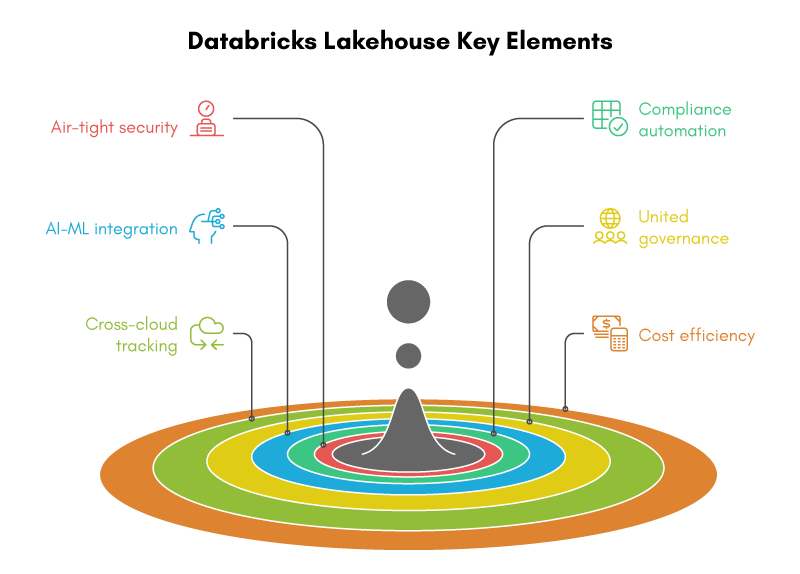
Enter Databricks Lakehouse 2.0, launched in July 2024, a game-changer that eliminates these hurdles. By combining cross-cloud lineage tracking, fine-grained access controls, and compliance automation, it empowers organizations to eliminate governance bottlenecks, reduce operational risk, and accelerate AI-driven innovation. By implementing Lakehouse 2.0, the manufacturer not only cut governance costs by 60% but also accelerated AI-driven decision-making, reduced security risks, and streamlined compliance processes.
In this blog, let me take you through Databricks’ latest innovations, and how they are redefining governance, enabling enterprises to move from reactive fixes to proactive intelligence. From addressing governance challenges to enhancing security and simplifying compliance, these advancements help businesses unlock the full potential of their data—without the complexity.
Cross-Cloud Lineage: A Unified View of Data Movement
The above cited manufacturer’s biggest governance pain point was data inconsistency across cloud environments. Disjointed data sources led to conflicting production forecasts, incorrect inventory levels, and delayed shipments, impacting revenue and customer satisfaction.
How Unity Catalog Solves This
- Automated lineage tracking for Delta Lake tables, Power BI dashboards, and OpenAI API calls.
- Real-time visibility into data flow from IoT sensors in factories to centralized analytics dashboards.
The manufacturer discovered that a $5M discrepancy in raw material procurement stemmed from a misconfigured Azure data pipeline. Before adopting Databricks, pinpointing such errors took weeks of manual analysis. With Unity Catalog’s automated lineage tracking, the issue was resolved in under 15 minutes, restoring confidence in production data.
Fine-Grained Security: Intelligent Access Without Bottlenecks
Previously, the manufacturer used broad access policies, exposing sensitive operational data to unauthorized personnel. On the other hand, overly restrictive policies hindered AI model development, forcing engineers to request permissions manually and slowing progress.
How Unity Catalog Enables Precision Access
- Enforces row-, column-, and cell-level security, allowing role-based access control.
- Dynamically restricts sensitive production data, preventing unauthorized model training.
— Enforce row-level security for compliance
CREATE ROW FILTER ProductionDataFilter ON manufacturing.operations
AS (current_user() = access_id);
— Assign specific access rights to factory supervisors
GRANT SELECT ON FILTER ProductionDataFilter TO ROLE supervisors;
Healthcare Case in Point
Enhancing Security for Healthcare Data
A leading healthcare provider faced growing concerns over patient data privacy while developing AI models to enhance diagnostic accuracy. Their challenge was to protect personally identifiable information (PII) while still enabling data scientists to extract meaningful insights from non-sensitive data fields.
By leveraging Unity Catalog’s fine-grained access controls, the healthcare provider implemented:
- Column-level security, restricting access to patient names and social security numbers.
- Row-based policies, ensuring only authorized physicians could view sensitive records.
- Automated masking, allowing AI models to train on anonymized data.
As a result, the provider reduced PII exposure by 90%, ensuring HIPAA compliance while accelerating AI-driven medical research. This breakthrough allowed the organization to develop predictive healthcare models faster without jeopardizing patient privacy.
Compliance Automation: Cutting Audit Times from Weeks to Hours
Regulatory audits were a major operational burden for the manufacturer, with compliance teams manually compiling reports across disparate systems. Lakehouse 2.0 changed the game by automating compliance workflows.
Previously, the manufacturer’s annual SOC 2 audit took three weeks. By adopting Unity Catalog, compliance teams generated the required reports in just two hours, saving the company $3M in compliance overhead annually.
Key Features Driving Compliance Automation
- AI-powered Data Classification: Auto-tags sensitive data (e.g., supplier agreements, production costs) to simplify compliance checks.
- Automated Retention Policies: Enforce GDPR’s ‘right to be forgotten’ with auto-expiring data.
- Pre-built Audit Templates: Generate SOC 2 compliance reports in hours instead of weeks.
Why Databricks Outpaces Snowflake in Governance
The manufacturer had previously considered Snowflake’s governance model, but it proved too rigid and costly. Unlike Snowflake’s proprietary approach, Databricks offers:
- No Vendor Lock-in: Works across AWS, Azure, and GCP using open data formats (Delta Lake, Parquet, ORC).
- Unified AI & BI Governance: Governs ML models and BI dashboards in a single framework.
- 40% Cost Savings: Eliminates expensive governance add-ons required in Snowflake.
How to Implement Databricks Lakehouse 2.0
Modern manufacturers generate vast amounts of data across production lines, supply chains, and multi-cloud environments.
Without a unified strategy, manufacturers struggle to maintain real-time visibility into operations, enforce security policies, and meet regulatory mandates.
Databricks Lakehouse 2.0 seamlessly addresses these challenges. Let’s look at the steps involved in implementation.
1. Upgrade: Strengthening Governance with Unity Catalog
While the manufacturer had a data catalog in place, governance lacked automation and standardization. Upgrading to Databricks Lakehouse 2.0 and Unity Catalog enabled them to:
- Centralize data governance across AWS, Azure, and GCP, ensuring uniform access controls.
- Implement fine-grained security policies, restricting access to proprietary manufacturing data.
- Enable cross-cloud data lineage tracking, providing real-time visibility into production and supply chain data.
- Automate compliance enforcement, reducing regulatory risks and audit complexities.
2. Migrate: Mapping Legacy Governance Policies to Unity Catalog
Before Databricks, governance policies were manually enforced, leading to inconsistencies and inefficiencies. By adopting Unity Catalog and Compliance Hub, the manufacturer:
- Mapped legacy governance policies into a unified security and compliance framework.
- Deployed role-based access controls (RBAC) to manage sensitive production and supply chain data.
- Enabled real-time tracking of raw material usage and product movement, optimizing inventory and demand forecasting.
3. Optimize: AI-Powered Governance for Smarter Manufacturing
Following migration, the manufacturer leveraged Databricks’ free Governance Assessment to optimize governance workflows:
- Automated quality control checks, using AI-driven anomaly detection to identify defects before reaching production lines.
- Applied security policies to AI-powered demand forecasting models, ensuring compliance while optimizing production planning.
- Reduced quarterly audit overhead by 50%, cutting governance costs by 60% and improving operational efficiency.
Through these steps, companies can transform their data governance frameworks into secure, AI-driven systems that enhance data reliability, mitigate compliance risks, and accelerate decision-making in real-time.
Conclusion: Governance as a Business Accelerator
By adopting Databricks Lakehouse 2.0, the manufacturer transformed governance from a compliance burden into a competitive advantage. With cross-cloud lineage tracking, fine-grained security, and compliance automation, they cut governance costs by 60% while accelerating AI-driven decision-making.
This shift from reactive governance to a strategic enabler empowers organizations to drive innovation and accelerate business growth.