Most conversations about Offshore Development Centers in India start with a cost slide. Sixty percent savings, maybe seventy. The number looks good in a board deck, and honestly, it’s not wrong; the math does work. But somewhere between that slide and month eighteen of running an ODC, many mid-market US companies discovered that the number was the easy part. Setting up a team that actually performs like an extension of your engineering org, one that knows your codebase, owns your roadmap, and doesn’t need hand-holding every sprint, that’s a different problem entirely. One that cost savings alone won’t solve.
This piece is about the fuller picture: what an Offshore Development Center in Bangalore or Hyderabad actually costs to set up right, what ROI looks like when the model is working, and what scaling without losing control requires. Written from the perspective of a team that’s built a few of these.
ODC vs. Outsourcing: The Model You Choose Determines the Return You Get
Before we talk numbers, we need to untangle something that causes a lot of confusion and a lot of expensive mistakes. Outsourcing and an Offshore Development Center are not the same thing, and treating them as interchangeable is one of the most common reasons ODC ROI projections fall flat.
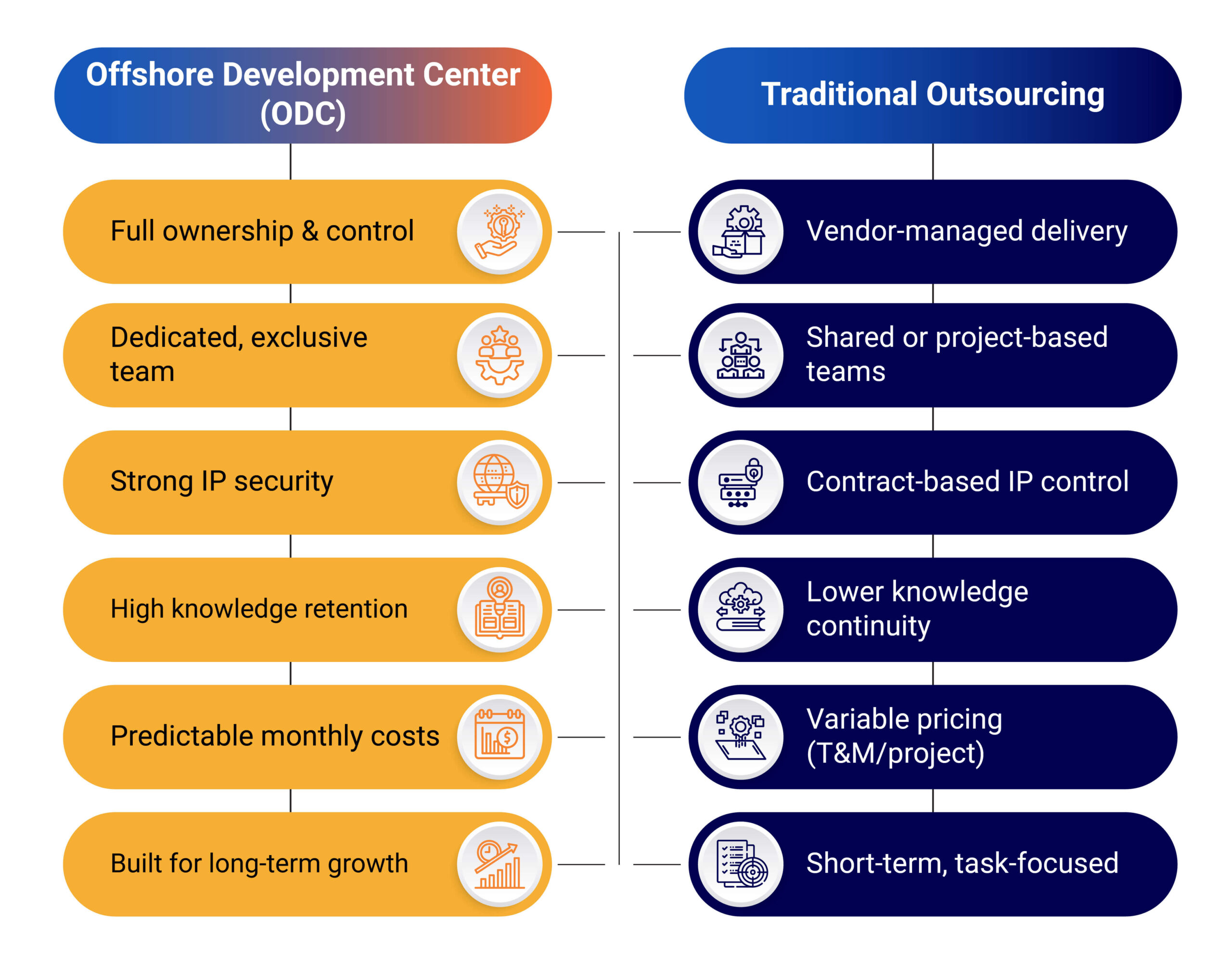
Traditional IT outsourcing is essentially a vendor relationship. You define a scope, a vendor assembles a team (that’s also working for three other clients), delivers to spec, and the relationship ends when the project does. You have limited visibility into how decisions get made, who’s actually on your account week to week, and whether institutional knowledge is building or walking out the door. It’s transactional by design.
An ODC is structurally different. Your dedicated development team works exclusively on your product, follows your processes, uses your tech stack, and critically, the institutional knowledge they build stays with you. You’re not buying deliverables from a vendor. You’re extending your engineering organization across a time zone.
That distinction matters enormously for ROI. With outsourcing, you’re often re-onboarding new vendor staff every 9-12 months, paying a knowledge tax every time. With a well-run ODC, your offshore team is getting better at your product over time, compressing ramp-up, reducing rework, and gradually taking on more complex responsibilities. That compounding effect is where the real return lives, and it doesn’t show up in a simple hourly rate comparison.
Why India, and Why These Two Cities
India isn’t a fallback for companies that can’t afford US talent. It’s the deliberate, strategic choice of enterprises that have spent years building some of the most sophisticated technology operations in the world. That ecosystem matters enormously for mid-market companies building Offshore Development Centers: the talent pipelines, compliance infrastructure, real estate, and institutional knowledge of running distributed engineering at scale are already well-developed. You’re not pioneering anything. You’re plugging into a mature, proven operating environment.
What India offers in 2026 that no other market matches is a combination of scale, depth, and maturity. India produces over 2.5 million STEM graduates annually, has the world’s second-largest English-speaking professional population, and has been running complex enterprise technology programs for global companies for over two decades. The ecosystem from talent pipelines to compliance infrastructure to real estate has matured to the point where setting up an ODC is not an experiment. It’s a known playbook.
Within India, Bangalore and Hyderabad are the two cities that matter most for technology-focused Offshore Development Centers and choosing between them is a real decision with real cost and capability implications.
Bangalore is the right base if your ODC will be AI-heavy, cloud-native, or deep-tech product engineering. The city hosts over 1,000 deep-tech startups alongside global R&D centers from Google, Microsoft, and similar firms, making it the densest enterprise AI talent market in India outside of the US and China. The talent depth in AI engineering, platform architecture, and DevOps is simply unmatched. The trade-off: senior developer salaries in Bangalore have been trending upward with demand, so your loaded cost per hire will be higher than Hyderabad, but for the right engineering profile, it’s worth it.
Hyderabad is the stronger call if you’re in fintech, healthtech, life sciences, or large-scale data engineering. Telangana’s state government has been proactive in its technology policy, offering plug-and-play infrastructure, tax incentives, and single-window clearance, which translates into faster setup timelines and slightly lower operational overhead. The city has particular depth in analytics, compliance-heavy engineering, and enterprise data platforms. If your product requires HIPAA-aligned development or financial-grade data handling, Hyderabad has the talent and the compliance culture to match.
The honest take: for most mid-market US tech companies, Bangalore is the default, but the smarter question isn’t “which city is better” but “where does the specific talent density for our stack and sector actually live?”
The Real Setup Cost: What No One Tells You Upfront
Here’s where most content on this topic gets vague, and where your planning gets derailed. Let’s be direct about the four cost buckets that actually determine what you spend in year one.
1 Legal Entity and Compliance
To operate an ODC in India, you’ll need a legal structure, most commonly a Private Limited company (Pvt. Ltd.), or you can operate through an Employer of Record (EOR) arrangement while your entity is being established. Going the Pvt. Ltd. route gives you full control, brand presence, and the cleanest path to IP ownership. It also takes 6-10 weeks to establish properly, with costs ranging from $8,000 to $20,000 depending on legal counsel, state-specific filings, and compliance setup.
What most first-timers underestimate here is the ongoing compliance overhead: labor law adherence, statutory deductions (Provident Fund, ESI, gratuity), payroll structuring, and data privacy requirements under India’s evolving framework. Getting this wrong in year one creates problems that are expensive to fix in year two.
2 Talent Acquisition
This is your highest first-year variable cost, and it’s where the gap between a thoughtful setup and a rushed one shows up most clearly. In Bangalore, a fully-loaded annual cost for a mid-level software developer, including salary, benefits, employer contributions, and overhead, typically runs between $25,000 and $40,000. In Hyderabad, that range is somewhat lower, often $20,000 to $32,000 for comparable seniority. Compare that to the US median of $133,080 for software developers (Bureau of Labor Statistics, 2024), and the cost differential is immediate and significant.
But the real talent acquisition cost isn’t just the salary. It’s the first 90 days: recruiting, background verification, onboarding, and the quality of your first lead hire. Your on-the-ground technical lead is the most consequential hire you’ll make. A great one builds your ODC culture from day one. A weak one costs you 6 months of compounding misalignment that’s very hard to unwind.
Companies building a 10-15 person ODC can expect talent acquisition costs, including search fees, onboarding, and tools licensing, to add 15-25% on top of base compensation in year one. These costs drop significantly in year two as the team stabilizes.
3 Infrastructure
The managed workspace model is almost universally the right call for first-time ODC builders at the mid-market scale. You’re looking at per-seat costs in Bangalore’s established IT corridors, including Whitefield, Electronic City, and Sarjapur Road, of roughly $150-$300 per seat per month for a fully managed, SLA-backed setup with redundant connectivity, IT infrastructure, and 24/7 operational support. Hyderabad’s HITEC City and Financial District corridors are often 15-20% more cost-efficient.
At a 15-person team, that’s $27,000 to $54,000 annually in infrastructure costs, a fraction of what equivalent US office space and IT overhead would run.
4 Governance and Tooling
This is the budget line most first-time ODC builders forget entirely, and it’s the one that determines whether your ODC actually performs like an extension of your team or drifts into a disconnected island.
Real-time productivity dashboards, SLA-based delivery tracking, AI-powered platform tools for governance, and structured sprint frameworks are not luxuries. They’re what keep your US and India teams operating as one unit. In 2026, purpose-built platforms that provide 360-degree visibility into offshore team performance, from velocity metrics to delivery health indicators, are increasingly standard in well-run ODC setups. Budget $15,000-$30,000 annually for this layer. The companies that skip it spend far more correcting the drift later.
The ROI Math: What Mid-Market Companies Actually See
Let’s put some shape around the numbers without overpromising.
For a mid-market US tech company building a 10-person ODC in Bangalore in 2026, a realistic year-one loaded cost, covering legal setup, talent acquisition, infrastructure, governance tooling, and salary, falls in the range of $450,000 to $650,000. The equivalent US team would cost north of $1.5 million in fully-loaded annual compensation alone.
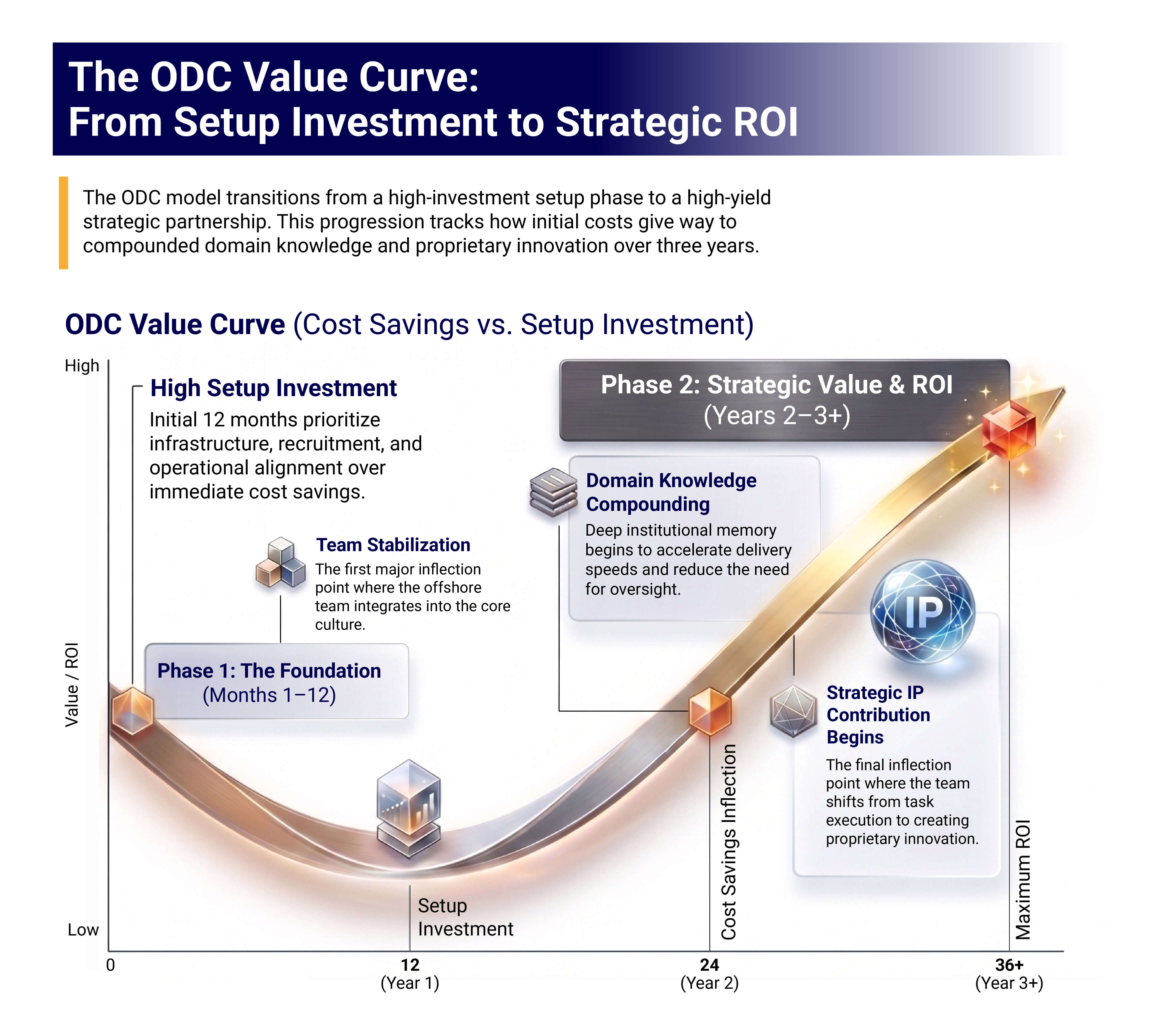
That’s a year-one saving in the range of $800,000 to $1 million, even after accounting for all setup costs and management overhead. Most companies targeting 60-70% cost savings against comparable US hiring see that number hold through year one, but only if the setup is done right.
Year two is where the model starts to compound. Setup costs are largely absorbed. Your team has a domain context. Ramp-up drag is gone. Attrition, if your hiring and culture work was done properly, is manageable. The savings accelerate, and you start seeing operational ROI in addition to cost ROI: faster sprint cycles, 24/7 development coverage across time zones, reduced time-to-market on releases.
Year three and beyond is where the strategic ROI shows up. IP built in-house. Engineering capability that scales without proportional cost increase. An offshore team that’s not executing for your product is a co-owner of it.
Enterprises that leverage 24/7 offshore development cycles report up to 30% faster time-to-market compared to single-timezone teams. For a product company where shipping velocity is a competitive lever, that number often means more than the direct cost savings.
Scaling Without Losing the Plot
Here’s the part that doesn’t get talked about enough: the transition from a 10-person ODC to a 30-50 person organization is where most mid-market companies experience their first serious growing pains, and it has almost nothing to do with cost.
What breaks at scale is governance. When your offshore team is 10 people, you can manage alignment through weekly standups and a strong tech lead. When it’s 35 people across three engineering pods, alignment requires actual organizational infrastructure: a site director or country head with genuine authority, defined escalation paths, clear ownership of delivery pods, and cultural integration that goes beyond a quarterly all-hands.
The delivery pod model, small cross-functional teams of 6-8 engineers, each owning an end-to-end product module, is increasingly the standard for ODCs that scale cleanly. Each pod has full-stack coverage, clear ownership, and direct accountability to a US counterpart. This structure prevents the diffusion of ownership that plagues larger teams.
Attrition management deserves its own honest conversation. Tech hub attrition in Bangalore and Hyderabad runs at 20-30% annually in some segments, and unmanaged attrition is expensive. Every departure in a knowledge-intensive team has a real cost: recruiting, re-onboarding, lost context, and delayed delivery. The ODCs that keep attrition in single digits are the ones that invest in career paths, continuous upskilling aligned to the product roadmap, and succession planning from day one. This isn’t HR box-ticking, it’s directly linked to your delivery ROI.
The frame that works best: your ODC at scale should have its own leadership identity, its own career growth infrastructure, and its own voice in product decisions. The companies that build that culture, where the India team knows the roadmap before the US team finishes the all-hands, are the ones reporting the highest long-term returns.
How Trigent Approaches This
Trigent has been doing this as an ODC enabler that builds, operates, and, where appropriate, transfers offshore capability to clients who want full ownership over time.
The Trigent model includes an AI-powered talent engine with a 250+ recruiter network, 24-hour turnaround on shortlisting, and 80% match rates against client requirements across 20+ technology domains. Infrastructure is SLA-backed from day one, with redundant connectivity, disaster recovery, and BCP protocols built into the setup, not bolted on later. Governance isn’t an afterthought: real-time productivity dashboards, 360-degree delivery visibility, and ISO 27001-ready compliance processes are part of how Trigent-managed ODCs operate from week one.
The Build-Operate-Transfer (BOT) model is particularly relevant for mid-market companies that want the strategic benefit of a fully-owned capability center without the full setup burden upfront. Trigent builds and operationalizes the center, managing talent acquisition, compliance, infrastructure, and governance, and then transfers full ownership once the team is performing and culturally integrated. The client ends up with an ODC that already feels like theirs, because operationally, it already is.
Most recently, Trigent partnered with Codec, one of Ireland’s largest Microsoft Cloud Solution Providers, to establish Offshore Development Centers in both Bengaluru and Hyderabad, structured on exactly this BOT model. “India has the talent density that our next phase of growth demands,” said Codec’s CEO. “The professionals who join us here will be part of a company that has invested in its people’s long-term development for over four decades.” That’s the kind of ODC that performs, because it was built as a long-term strategic asset, not a quick cost fix.
For mid-market US companies evaluating the ODC path, the right question isn’t “can we afford to do this?” It’s “Can we afford to wait?”
The Window Is Narrowing
This isn’t manufactured urgency. The structural advantages of building an Offshore Development Center in India right now, including talent availability, infrastructure maturity, government policy support, and the growing depth of the technology ecosystem, are real. But they’re also attracting more entrants every quarter. First-mover advantage in talent pipelines and institutional knowledge is not quickly recoverable. Deep, stable ODC teams take years to build. Starting in 2026 means arriving at maturity ahead of competitors who wait until 2028.
For mid-market US companies sitting on the decision, the data is clear. The cost delta is real. The ROI compounds. And the companies that treat their ODC as a second headquarters, not a vendor, not a budget line item, but a genuine extension of their engineering organization, are the ones building structural competitive advantages that will be very difficult to replicate.
The question is whether you want to be building that advantage now, or catching up to it later.
Explore Trigent’s ODC and Offshore Development Services