Given its part-success, part-failure story – can SAP really help small businesses?
80% of the Fortune 500 uses SAP.
80% of the Forbes Global 2000s are SAP customers.
98% of the most valued brands use SAP for their everyday operations.
There should be no question of SAP’s commanding presence in the ERP space. Its full extent of features and functionalities proves indispensable for conglomerates whose operations span across the globe.
But is it really worth it for small businesses? Would it be ideal for a small business (less than 50 users) to adopt SAP? There is a reason why SAP B1 or SAP S/4 HANA enjoys about 70,000 customers most of which are SMBs. Still, the perception of complexity and some high profile failures comes in the way of more SMBs adopting SAP consulting services for their implementation needs.
However, think again. Implementation of any ERP is fraught with challenges, not just with SAP. Given the customer base and popularity that SAP enjoyed, its challenges echoed far more within the SAP ecosystem than it had with other ERP systems.
SAP Implementation Challenges
So, SAP or otherwise, what’s really behind all the complexity and challenges?
Across our deployments, Trigent observes 3 factors emerging as a common theme and contributing to the implementation complexity of SAP and other ERP systems.
Usability. Accuracy. Flexibility – fundamental tenets of a successful ERP system.
Put it another way – almost all the complexity and challenges with SAP implementation are linked to problems of usability, inaccuracy, and a rigid system incapable of accommodating the needs of the users.
These in turn are closely connected with 3 dimensions of business functions that the ERP system is required to support:
- Supporting Processes
- Business Enablers
- Market Differentiators
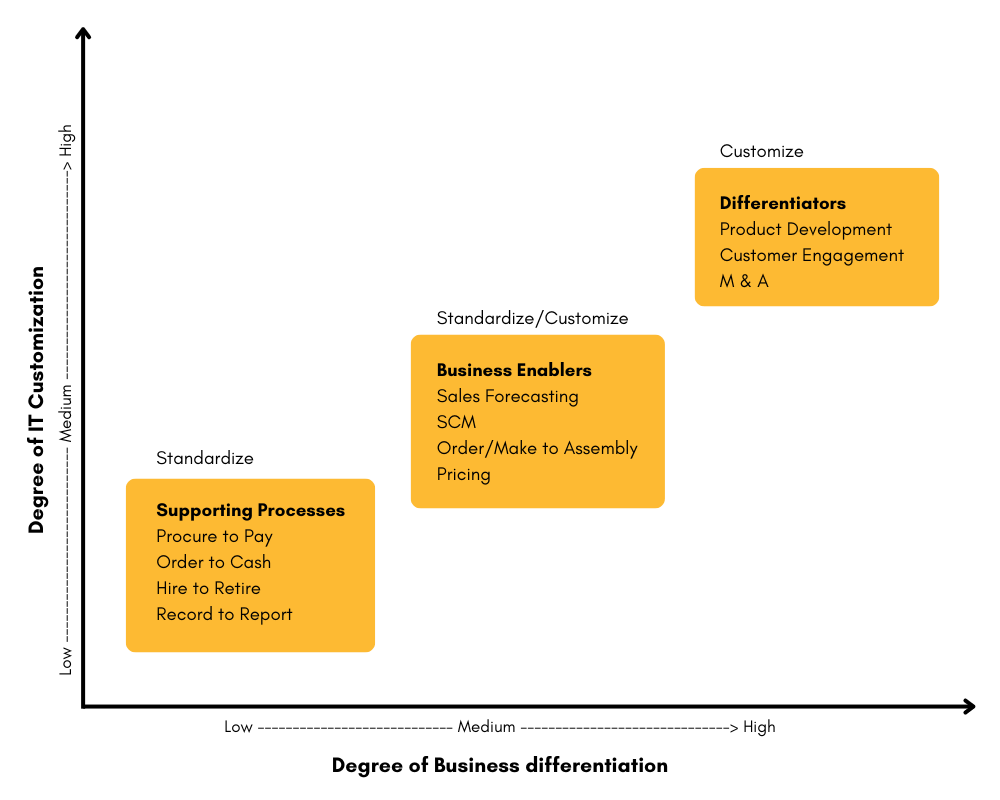
Supporting Processes (ties to Usability)
These are routine every-day operations. The volume of these transactions is high, they are typically handled by front line staff and play a negligible role in helping the SMB gain a competitive advantage.
- Procure to Pay
- Order to cash
- Hire to retire
- Record to Report
In an ideal state, all these tasks have to be completed through SAP. However, in failed implementations, employees did not use the system because the modules were unusable. The companies wanted to customize these routine processes to fit their existing workflows, which resulted in unnecessary complexities. These processes are honestly better off with standardization. (Refer figure above)
Business enablers (ties to accuracy)
These are essential activities that have a visible impact on the customer experience. When executed well, they generate a positive image for the company in the market and contribute to the brand perception.
- Sales Forecasting
- Supply Chain Management
- Order/Make to Assembly
- Pricing
Even if you use the system, you must be working on accurate data. Otherwise, you can’t make the right predictions. Accurate data is only possible if the many processes are closely integrated. Only a healthy mix of standardization and customization could make these integrations possible. But this is where things get messy. Companies really did not know where to draw the line when it came to customizing or standardizing.
Experts from SAP consulting services like Trigent help enterprises see through the nuances and apply the best practices that help businesses gain from their market experience.
Differentiating processes (ties to flexibility)
These are core programs that set a company apart from their competition. They define the value that companies aim to deliver to the market and the strategy they employ to scale and gain market share
- Product development
- Digital customer engagement
- Mergers & Acquisitions
These processes stand for acceleration, enabling the company to outsmart the competition and steer toward the future. Suffice it to say, these processes demand a high degree of customization. If the software is slow or inflexible – the processes fall flat.
Point to note: Implementations across ERP systems failed because the companies got the mix (standardization/customization) wrong.
It naturally ended in poor usability, inaccurate data, and a rigid, inflexible system.
But here is where SAP stands out among other ERPs.
SAP B1 boasts of a higher product technology, a testament to its high flexibility and integration capabilities. The unanimous positive reviews on intuitive user interface and data consistency have made SAP B1 an undeniably attractive option for SMBs.
We stress its attractiveness because, for one, it comes as a SaaS option. You pay only for the features that you use. Also, SAP B1 has struck a balance between standardization and customization. The supporting processes are designed with preconfigured workflows which minimizes the need for customization. And even if you want to customize, the product gives you greater flexibility to customize processes related to business enablement and differentiation.
SAP B1 or SAP S/4 HANA
Remember, SAP B1 best caters to organizations with up to 500 employees. Beyond that size, SAP S/4 HANA seems to be the ideal solution. The software comes with all the features of B1 plus predictive analytics and real-time reporting for enhanced decision-making. But it all comes down to implementation.
Get Your SAP Implementation Right with Trigent AXLR8 Labs
Trigent AXLR8 labs has delivered custom solutions for over 29 years. We have demonstrated expertise across 400+ product lines. We are recognized as #1 in quality by Everest, Zinnov, and NelsonHall.
Trigent’s end-to-end consultation and managed services mean you can adopt a zero-maintenance strategy, reduce IT complexities, and accelerate your digital transformation.
Take a call with Trigent’s experts and clarify all your concerns regarding SAP implementation.
Define SAP Implementation Roadmap. Consult Us Today!