The retail bank embarked on a multi-year restructuring program to transform its UK operations into an agile, efficient entity with a reduced cost base. Under this program, the organization consolidated systems, streamlined back office processes of its Loan and Savings product lines, and simplified customer journeys.
The new operating model covered more than 40 functional and system-level integrations with the loans and savings product lines. They wanted to ensure that applications perform as expected even with bandwidth constraints, as well as:
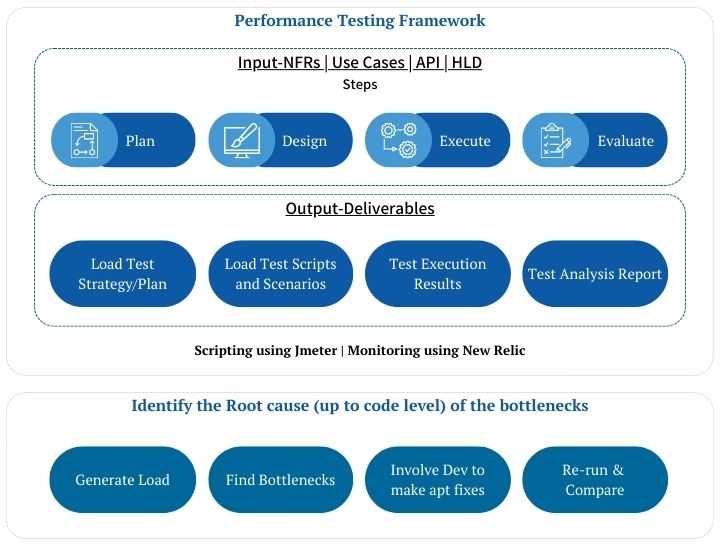
Investing in continuous testing services was essential as the client consolidated 40+ systems and integrations across product lines. The unified solution required every change to be comprehensively validated across systems and processes. Trigent’s team, with over 30 years of industry and technical experience, expedited the design and setup of the Test framework in the pre-production environment.
The Trigent team created a web application test suite to validate the customer portals. Besides Functional Testing, non-Functional Tests verified response time, throughput error rate, CPU, and memory usage. Performance tests, such as smoke, benchmark, iterative load, stress, endurance, spike, and volume tests, were done to assess end-to-end application responsiveness. The development team would alter the design and hardware configuration based on the dry-run results.
API performance testing strategy ensured the proper functioning of the programming interfaces. SIT, and UAT environments were used for test execution. A series of iterative tests for varying loads were conducted, and the team generated interim performance reports encapsulating: