Case Studies
Our client is a modern legal tech platform that reimagines the way legal claim settlements are negotiated. Designed for speed, security, and fairness, our client enables parties to settle disputes through a unique, double-blind negotiation model. This process reveals both initial offers and demands simultaneously, eliminating bias and promoting equitable dialogue.
Built with scalability and integration in mind, our client leverages algorithm-driven iterations in a neutral workspace to help parties arrive at a fair compromise in a faster and more cost-effective manner than traditional mediation. Notably, users are never bound to an offer or demand unless a settlement is reached, and fees are only incurred when a successful agreement is made. This outcome-based approach makes our client a compelling alternative in the legal settlement landscape.
Legal service providers are increasingly adopting digital platforms for client collaboration and workflow management. However, two areas remain complex and fragmented: legal claim negotiations and settlements.
For law firms and legaltech companies, integrating negotiation logic into existing Legal Practice Management Softwares (PMS) like Clio, Filevine, and Smokeball remains a challenge due to disparate data systems, absence of seamless APIs, and the nuanced, human-centric nature of dispute resolution.
Our client experienced this challenge firsthand which impacted scalability, integration agility, and user onboarding experience.
Integrating with tools like Clio or Filevine requires flexible APIs, standardized data handling, and an intuitive UX. As case volumes grew, the rigid architecture needed the ability to scale, integrations had to be seamless and cost and time-friendly, and onboarding new users had to be uninterrupted and smooth.
Additionally, negotiations in high-stakes legal cases are complex and require intelligent decision support. Our client’s platform required AI-driven insights and gamified interactions to help users arrive at fair resolutions quickly.
While the platform’s design promised equitable resolution, it lacked real-time intelligence. Tools such as contextual user guides, behavioral insights and dynamic suggestions would help users navigate complex negotiations rather than rely solely on gut feel in high-stakes decisions.
More so, The lack of seamless Single Sign-On (SSO) and secure, automated data exchange created friction for law firms who expected interoperability and rapid adoption.
To support their growth, the client needed a partner who could not only enhance their core negotiation engine with the power of AI and Gen AI, but also future-proof the platform with scalable architecture, secure integrations, and intelligent automation.
What began as a novel concept faced the realities of enterprise-wide technology adoption.
Trigent evaluated the client’s existing architecture and understood that for our client to be competitive, it was important to modernize their platform with features that would make it stand out in the market.
Our goal was not just to fix pain points but to elevate the entire platform experience, from how legal data moved to how users made decisions.
Every layer of the solution, from data to design to intelligence, and infrastructure, was reimagined through the lens of AI and platform modernization.
Our client’s platform was built as a monolithic application with a PostgreSQL backend. As traffic increased, it became clear this architecture couldn’t keep up with demands for dynamic scalability, custom workflows, or multi-system interoperability.
Trigent rearchitected the platform using scalable design principles – decoupling layers with Model View Controller, optimizing DB performance with indexed queries and partitioning, and laying out a clear microservices transition roadmap. This unlocked dynamic scalability, customizable workflows, and future-ready interoperability.
Most legal firms were already using tools like Clio, Filevine, and Smokeball. However, integrating with these platforms proved difficult due to schema inconsistencies and the absence of an abstraction layer. The result? Manual workarounds, delayed updates, and poor data hygiene.
Trigent engineered secure, API-first connectors to platforms like Clio, Filevine, and Smokeball. Our schema mapping layer standardized inconsistent data structures, eliminating manual workarounds and enabling real-time, bidirectional sync. The result: fully integrated legal workflows that just work.
Legal professionals expected frictionless entry – SSO logins, secure credentials, and seamless platform switching. Instead, onboarding was clunky and time-consuming, eroding early trust and increasing dropout rates. We streamlined user entry with SSO, API key-based auth, and role-based access. Onboarding shifted from days to minutes – driving adoption and making the first user interaction feel effortless and secure.
We redesigned the client’s existing negotiation engine using a gamified algorithm that could simulate user behavior, predict optimal moves, and drive faster convergence. This wasn’t basic automation, it was dynamic intelligence adapting to real-time user actions.
Automated notifications, job queues, email triggers, system logs, these critical backend workflows weren’t optimized for scale. And with limited observability tools, any breakdown became hard to trace, let alone fix.
To address performance bottlenecks and operational blind spots, we integrated Redis and Sidekiq to manage asynchronous background jobs such as email scheduling, status updates, and system notifications. This ensured that high-volume tasks could be processed in parallel without blocking the user experience. Additionally, we implemented a centralized issue tracking dashboard and incident reporting framework to provide real-time visibility into job queues, system logs, and error events, making failures easier to trace, debug, and resolve proactively.
As for the platform’s security, we embedded military-grade security protocols – AES encryption, API tokens, and Cloudflare DDoS protection, ensuring end-to-end data integrity and compliance with industry standards. Trust is now built into the platform’s DNA.
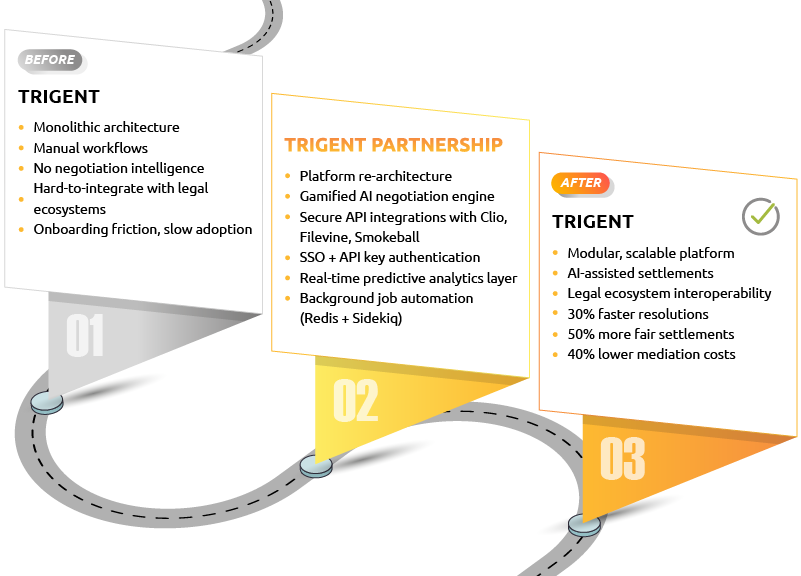
Through Trigent’s solution, our client was able to achieve:






We are happy to answer any questions you may have.
Fill in your details below and our team will get back to you shortly.