
Industry’s first Unified AI Management Platform enables Companies to Manage Gen AI Adoption, Track Usage and Boost AI Observability
Case Study
Industry’s first Unified AI Management Platform enables Companies to Manage Gen AI Adoption, Track Usage and Boost AI Observability
About the Client
Our client offers an enterprise-grade AI management platform, built to unify, govern, and optimize the use of generative AI across business functions. Designed for organizations navigating the complexities of modern AI ecosystems, our client enables seamless access to multiple AI tools while offering complete visibility, control, and compliance at scale.
By centralizing AI usage management into a unified workspace and embedding robust observability, our client empowers enterprises to transform fragmented AI adoption into structured, observable, cost-efficient operations. From prompt customization to real-time AI usage analytics, our client is redefining how businesses adopt and scale generative AI securely, intelligently, and efficiently.
Business Challenge
As enterprises race to integrate generative AI into their operations amid the proliferation of AI tools, they are faced with a paradox. The mission to accelerate productivity has spiraled into a tangled web of disconnected tools. Each department has adopted AI solutions independently—often without IT oversight or strategic alignment, resulting in a fragmented ecosystem of isolated interactions, AI chat histories trapped in browser tabs, duplicated efforts across teams, and no shared intelligence layer to build upon.
Despite increasing reliance on AI for everyday tasks, there is zero visibility into how AI is being used or whether it is delivering business impact.
The lack of centralized observability makes it impossible to track usage trends, compare tool effectiveness, or evaluate business ROI. AI costs spiral with prompt duplication across tools and users, inflated token consumption, and wasted token usage as a result of parallel access to the same content source. Engineers are burdened with integrating and maintaining multiple APIs, each with its own implementation for authentication, rate limits, and error handling, stretching resources thin and slowing down innovation.
At the same time, Gen AI performance metrics, such as prompt latency, accuracy ratings, or user satisfaction, are not available to guide optimizations or measure success. Security and compliance risks mount as AI tools process sensitive data without encryption, access control, or audit trails that trace where data is going or how it is stored.
They partnered with Trigent to build a unified AI workspace and unlock enterprise-wide intelligence.
Fragmented AI Adoption
Lack of AI Observability & Insights
Escalating Costs & Operational Overhead
Compliance & Security Gaps
Poor Personalization & User Fatigue
In their quest to build the industry’s first Gen AI Observability and Management Platform, the client chose Trigent as their technology partner, drawn by Trigent’s breadth of Gen AI technical proficiency, expertise in enterprise AI implementation, cloud infrastructure, and API orchestration.
Trigent Solution
Working in close collaboration with the client, Trigent conceptualized and designed a solution that helps Enterprises evolve from fragmented, isolated AI implementation to a centralized, measurable, and secure AI adoption platform. Every layer was designed to solve real organizational pain, with full transparency into why each component mattered and how it unlocked business value.
Trigent quickly concluded that the challenges of fragmented AI usage, skyrocketing costs, lack of observability, and critical security gaps couldn’t be solved by simply building another AI tool. And there aren’t any out-of-the-box solutions. A new, bespoke solution needed to be developed to unify the management of AI adoption across the enterprise.
Solution Highlights
Infrastructure Evaluation
Infrastructure Evaluation
Unified AI Workspace
Unified AI Workspace
Data Backbone & AI Observability
Data Backbone & AI Observability
Generative Scale & Personalization
Generative Scale & Personalization
Cost, Security & Scalability Framework
Cost, Security & Scalability Framework
The Discovery Phase
We began with the analysis and documentation of the client’s existing scattered ecosystem, their immediate need for observability, and the long-term necessity to create a scalable, secure AI backbone. Our approach mainly included merging strategic architecture, AI performance engineering, and the wisdom of cloud-native practices to build a future-proof solution.
Using the information gathered during this phase, Trigent determined the tech stack required for the various components, evaluated the available alternatives and recommended the preferred option for client approval, as illustrated below.
| Tech Stack | Why Selected | Alternative | Pros | Cons | When to use alternative |
|---|---|---|---|---|---|
| Frontend: React.js with TailwindCSS | Modular, performant, team familiarity | Vue.js Angular |
Lightweight, easy syntax All-in-one framework |
Smaller community, less enterprise use Heavier, less agile |
Vue: for fast MVPs Angular: for enterprise-grade systems |
| Backend: Node.js with Express | Event-driven, fast, same language as frontend | FastAPI Golang |
Async-ready, simple Fast, scalable |
Less performant under high load Steep learning, slower dev cycle |
FastAPI: Python-heavy teams Go: performance-critical services |
| Database: PostgreSQL (from Supabase) | Robust joins, indexing, scale support | Supabase MongoDB |
Rapid prototyping Flexible schema |
Limited scaling Weak on relational logic |
Supabase: MVPs Mongo: unstructured data |
| Agent: Electron.js | Node support, large plugin ecosystem | Tauri NW.js |
Secure, lightweight Easy legacy support |
Small ecosystem, Rust req Old APIs, less maintained |
Tauri: lightweight modern agents NW.js: legacy transitions |
| AI Models: OpenAI GPT, Claude, Gemini | Client requirements. Balanced output quality, availability | LLaMA 2 Claude |
Deploy locally Long-context tasks |
Heavy infra need API quotas, latency |
LLaMA: cost-sensitive secure apps Claude: legal/enterprise flows |
| DevOps: AWS, GitHub Actions | Flexible, integrated CI/CD | Azure DevOps Heroku |
MS stack friendly Quick deployments |
Less flexible Scaling limits |
Azure: MS stack shops Heroku: test/demo apps |
Building a Customized Unified AI Workspace
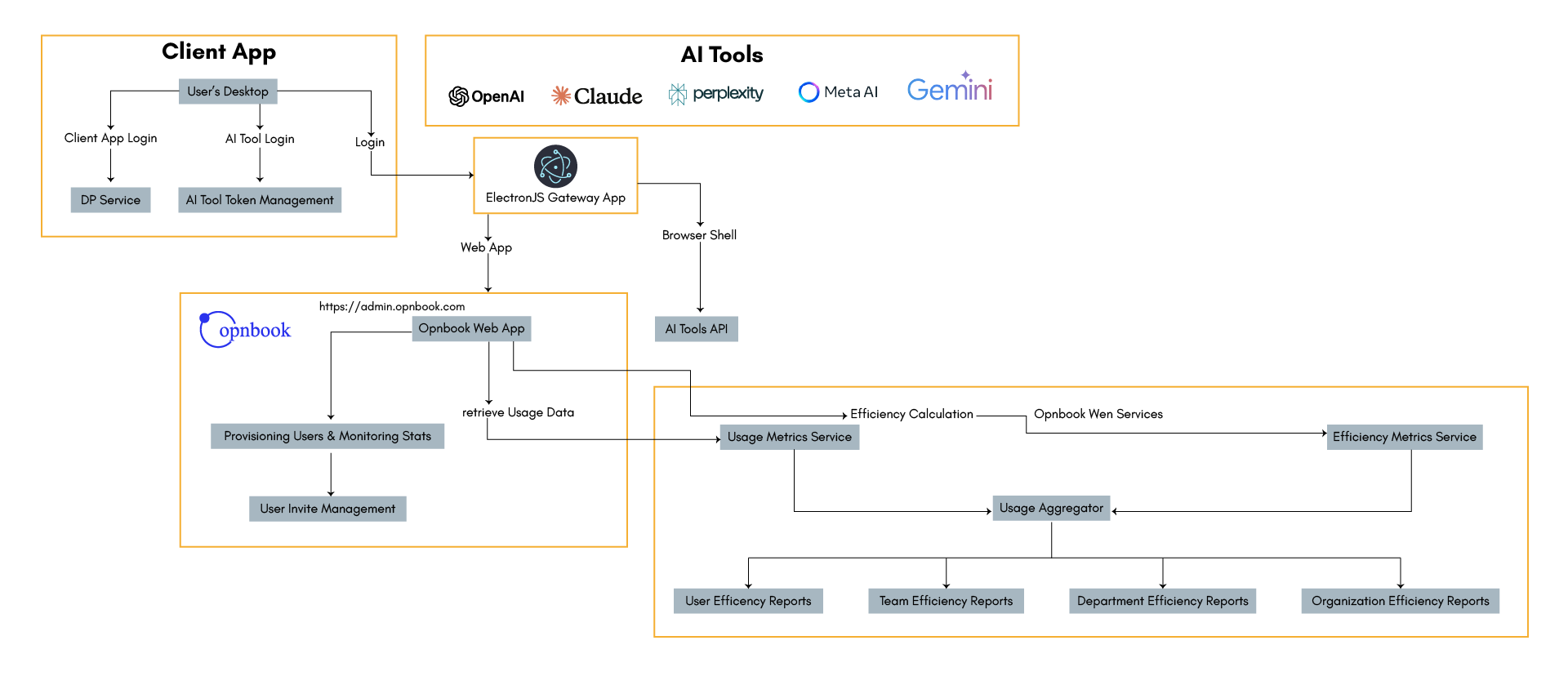
The first critical step was to eliminate the fragmentation. We designed and delivered a Unified AI Workspace, consolidating multiple generative AI models like ChatGPT, Gemini, and Claude into a single, desktop-based ElectronJS application.
This upgrade solved the root problem of users constantly switching between tools, losing session continuity, and duplicating efforts. A role-aware model switcher ensured users could pick the right AI model depending on the task, whilst maintaining their context. We wrapped this in a modern, responsive React + TailwindCSS UI to reduce onboarding friction and increase adoption. Embedded alerts were added to inform users about AI usage, model updates, and efficiency insights, thereby ensuring transparency and control at the user level.
AI Observability and Operational Efficiency
In parallel, we re-architected our client’s data infrastructure, replacing the limited Supabase setup with a robust PostgreSQL-powered data lake capable of handling over 93 million AI interaction records. We implemented real-time ingestion, summarized data for fast queries, and enabled role-based segmentation, allowing our client to unlock deep and granular analytics for the first time.
Once the data backbone was in place, we focused on AI Observability and Operational Efficiency. We engineered a full-fledged observability framework that captured every relevant metric, from prompt latency, token counts, and error rates to user feedback and efficiency scores. This data wasn’t just collected – it was visualized through actionable dashboards comparing AI performance across departments and use cases, helping the leadership pinpoint what was working and what wasn’t.
Generative AI Scale Engine
We introduced a Generative Scale Engine to solve the recurring problem of generic AI responses. By building a role-aware prompt templating engine, we enabled AI outputs to adapt dynamically based on the user’s department, role, and task, driving trust and usability. Teams could now configure curated prompts aligned with their domain, ensuring that a legal analyst didn’t get AI responses sounding like marketing copy.
Finally, we built an API & Token Efficiency Engine to identify redundant prompts, cache frequent requests, and implement token optimization strategies, reducing AI model usage costs by 25% without sacrificing output quality.
Cost, Security, and Scalability
From an infrastructure standpoint, we migrated our client to a secure, scalable AWS foundation with microservices, auto-scaling, and OpenAPI-compliant APIs, enabling seamless growth and workload isolation.
Security was embedded by design, with OAuth 2.0 authentication, AES-256 encryption, RBAC, CIDR-scoped SSH access, and full audit trails to ensure readiness for SOC2, HIPAA, and GDPR compliance. Recognizing the platform’s growing complexity, we also integrated automated testing pipelines and performance benchmarks to guarantee sub-second AI responses even under peak load.
In short, every design choice was deliberate, not just to make AI usable, but to make it enterprise-grade, observable, compliant, and cost-efficient. Trigent’s deep expertise in cloud infrastructure, product engineering, and performance engineering, ensured that we were able to design and implement a scalable, secure solution that not only integrated disparate AI tools but also optimized performance and ensured long-term sustainability.
Client Benefits
- Unified AI experience: Single workspace with ChatGPT, Gemini, Claude integration.
- Visibility into AI value: Full-stack observability, real-time efficiency scoring, and usage analytics.
- Cost containment: 25% reduction in model and API expenses through optimization.
- Scalable data intelligence: 93M-record data lake with fast-access summaries for analytics.
- Context-aware AI output: Role-specific prompt engineering and response tuning.
- Security & compliance: SOC2, GDPR, HIPAA-ready platform with full access control and encryption.
- Enterprise-grade deployment: AWS-hosted, microservices-based, auto-scaled architecture.