
Building a Best-in-Class, Cost-Efficient, and Scalable AI Platform for Legal and Business Consulting Firms
Case Study
Building a Best-in-Class, Cost-Efficient, and Scalable AI Platform for Legal and Business Consulting Firms
About the Client
Our client offers a next-generation AI-powered consulting platform built for business consulting firms, law practices, and enterprises, to optimize strategy, operations, and boost growth. It empowers internal teams to make smarter decisions by leveraging AI tools to conduct surveys, process responses, undertake AI-driven analysis, collaborate on strategies, track operational workflows, perform deep case-by-case analysis, and drive measurable results through intelligent, data-backed AI recommendations.
Business Challenge
The challenges that our client faced required a fresh look keeping the future business requirements in context. The current platform served the startup phase of the business. The scaleup phase demands a flexible, robust architecture, designed for scale, security and operational flexibility.
Trigent Solution
The challenges that our client faced required a fresh look keeping the future business requirements in context. The current platform served the startup phase of the business. The scaleup phase demands a flexible, robust architecture, designed for scale, security and operational flexibility.
The Discovery Phase
During our in-depth assessment, we uncovered several critical limitations across its AI infrastructure, application architecture, and scalability model. The AI layer was fragmented and AI workflows operated in silos, with no feedback loop or observability framework to monitor performance or support iterative model training. We also identified inefficient model selection logic, where large models were overused for simple tasks. Lack of contextual intelligence meant that the AI’s responses were off by a huge margin. These issues caused duplication, hallucination, and excessive token usage, long inference times, and inflated compute costs.
Compounding the issue were severe infrastructure and application performance bottlenecks. The Next.js application was slow, unresponsive under heavy workloads, and lacked the scalability needed for enterprise use. More so, the reliance on third-party services created vendor lock-in, restricting flexibility and limiting observability, while also introducing latency and security concerns. The platform also lacked proper access controls or data protection mechanisms, struggling to meet enterprise-grade compliance standards.
Here’s how we went about solving each of these challenges, one by one.
AI Fine-Tuning, Real-Time Feedback, and Contextual Intelligence
To overcome the challenge of generic and unreliable AI outputs, Trigent fine-tuned NLP models using historical engagement data, consultant annotations, and firm-level operational patterns. This enabled the delivery of highly relevant, role-specific recommendations aligned to the unique context of each user.
A real-time feedback loop was implemented to track user interactions, feed back into the training pipeline, and enable iterative refinement of model behavior based on real-world usage.
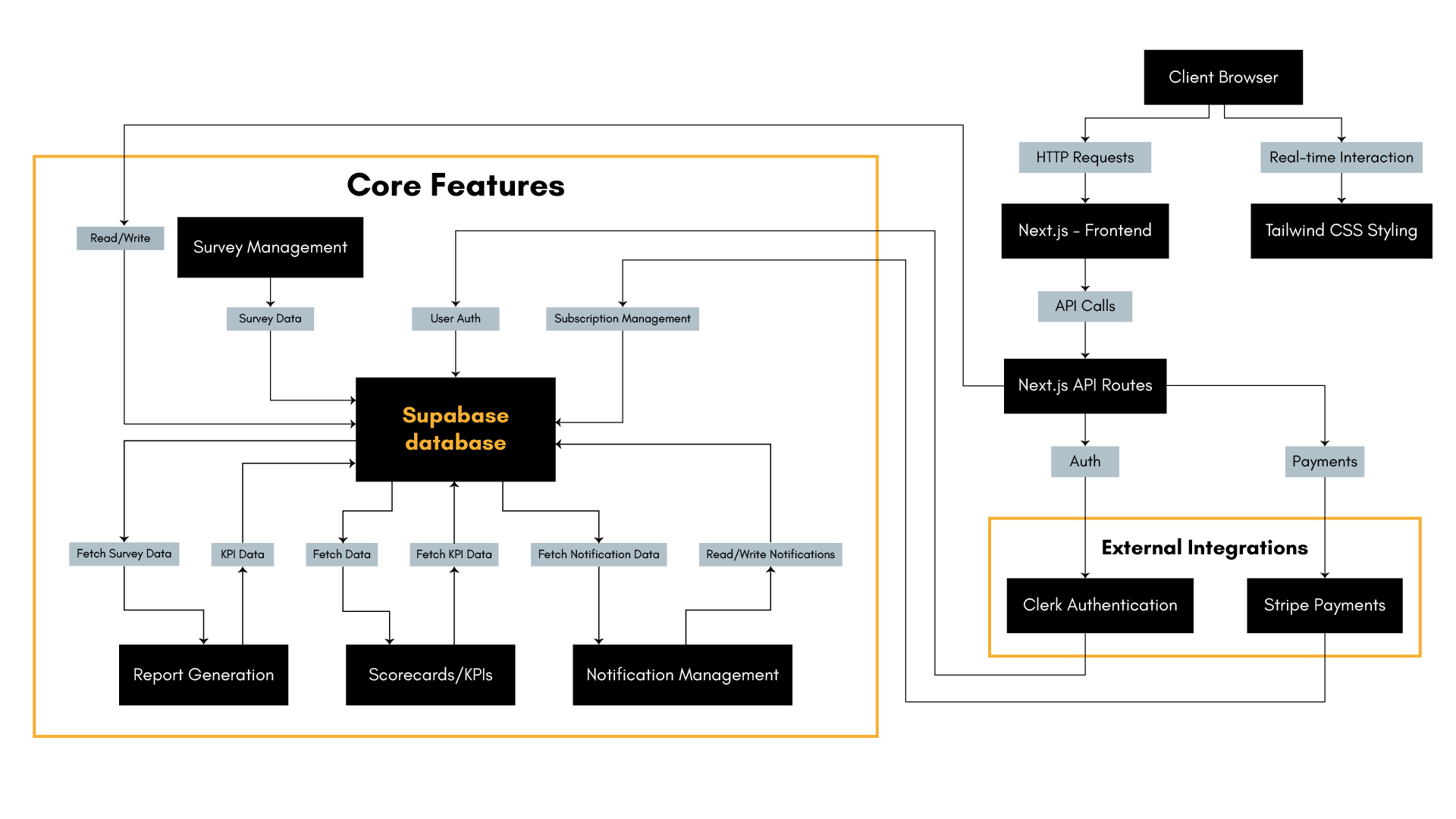
We achieved contextual intelligence by implementing a vector-based memory layer using Supabase, allowing the AI to retain and recall historical interactions that improved continuity in conversations and recommendations. This architecture allowed the system to reference prior context across sessions, making outputs more consistent and insightful.
To reduce redundant processing and accelerate response times, we added a persistent caching layer for frequently accessed insights, while also optimizing database queries to lower backend strain.
Optimized AI Routing and Dynamic Model Switching for Cost and Performance Efficiency
We identified that our client’s initial AI implementation relied heavily on large language models (LLMs) for all tasks, regardless of complexity, resulting in high compute overheads, increased latency, and unpredictable system performance. Trigent conducted a thorough audit of AI call patterns and introduced a strategic model routing framework that aligned model selection with task complexity, user role, and contextual depth.
We developed a real-time task classification layer that intelligently analyzed incoming requests to determine the optimal model path. By doing this, we ensured Lightweight models were used for simple operations like tagging and summarization, while high-context interactions were routed to more advanced LLMs. This dynamic switching reduced unnecessary LLM calls by over 40%, significantly lowered AI processing costs, improved inference speed, and delivered a more responsive, adaptive experience—particularly during periods of high platform activity.
Langfuse Integration for Real-Time AI Monitoring and Observability
Addressing the data observability challenge, Trigent integrated Langfuse—a powerful observability platform for AI pipelines. This gave the client real-time visibility into AI model performance across metrics like latency, success rates, user engagement, and error tracking across LLMs.
With Langfuse, teams could now monitor and debug model behavior, compare prompt effectiveness, and trace output quality over time, unlocking a feedback-rich development environment. We also introduced CI/CD pipelines purpose-built for AI workflows, with test harnesses to validate model outputs before production deployment, ensuring faster iteration without sacrificing trust or stability.
Cloud Infrastructure, Security & Observability
Trigent developed a comprehensive cloud modernization strategy using AWS to eliminate 3rd party dependencies and vendor lock in. The AWS migration involved a full transition of hosting, identity, and data lake services that resulted in full infrastructure control and ownership. We then designed a scalable AWS-based data lake architecture tailored to support both real-time and batch AI/ML workloads, ensuring the platform could efficiently handle increasing volumes of business data.
To ensure security, Trigent implemented enterprise-grade protections including AES-256 encryption, OAuth2 authentication flows, and RBAC (role-based access control), all aligned with SOC2 and GDPR requirements.
Next.js Application Enhancements
To resolve performance bottlenecks that impacted self service user experience and enterprise users accessing large datasets, Trigent optimized the fullstack Next.js application. It included a modular frontend and backend, enabled component reusability and hastened developer onboarding. Server-side rendering (SSR) and static site generation (SSG) were implemented to reduce Time to First Byte (TTFB) and improve SEO performance.
For real-time collaboration, we introduced WebSocket-based live data refresh capabilities, enhancing responsiveness for consultants. The UI/UX was overhauled to meet WCAG accessibility standards, ensure device responsiveness, and present data more intuitively. Finally, we fortified the application with OAuth2, JWT authentication, and form sanitization to protect against injection attacks and unauthorized access.
Client Benefits
Through Trigent’s comprehensive solution, our client realized significant platform-wide improvements:
- Decision-making accuracy improved by 35%, driven by context-aware, role-specific AI recommendations that enabled consultants to act with greater confidence.
- Report generation speed increased by 40%, thanks to intelligent caching mechanisms and the integration of batch APIs that streamlined data processing.
- AI processing costs were reduced by 25%, through optimized token usage, lightweight model routing, and elimination of redundant inference calls.
- 100% AWS migration readiness was achieved, delivering full infrastructure control, enterprise-grade security, and scalability without vendor lock-in.
- Real-time AI performance monitoring was enabled, with dashboards that provided clear visibility into error rates, model behavior, and system health—supporting continuous optimization.