
White Paper
Powering the Pulse of Healthcare with Operational AI
Unified AI Solutions Optimize Core Healthcare Operations
Executive Summary
Healthcare operations have made steady progress in adopting AI to enhance tasks such as billing, scheduling, and budgeting. But these efforts often happen in silos with partial automation and manual handoffs. The real opportunity and challenge lie in integrating these silos and enabling data flow to create seamless, end-to-end operations powered by shared intelligence. Achieving this starts with standardizing data across departments, create a centralized data store that serves as the source of truth and integrate AI tools onto the unified operational platform.
The road to standardizing data begins with identifying data sources and defining a format that can be applied organisation-wide. Clear protocols must be defined on how data should be collected, shared and maintained across departments. Once all the data is collected and unified into an operational platform, organizations can then evaluate AI applications and tools that utilize the data, suggest actions and seamlessly integrate into the recommendations within defined workflows. The chosen AI solutions should comply with HL7 and FHIR standards and be designed to be interoperable, scalable, and effective in healthcare environments.
Partial Automation & Manual Handoffs Limit Automation’s Effectiveness
AI has delivered clear benefits in operational functions like revenue cycle, workforce management, finance, supply chain, and other operational areas. But in most healthcare settings, these solutions address only a few isolated parts within each function. For instance, tools may help reduce claim denials or automate staff scheduling, but they rarely extend across the full process. Their impact stops at the edge of a department.
Fragmented data, incompatible systems, and limited coordination between departments continue to limit the value AI can deliver. The challenge today is how to integrate AI across entire operational workflows to drive connected, continuous value across the healthcare enterprise.
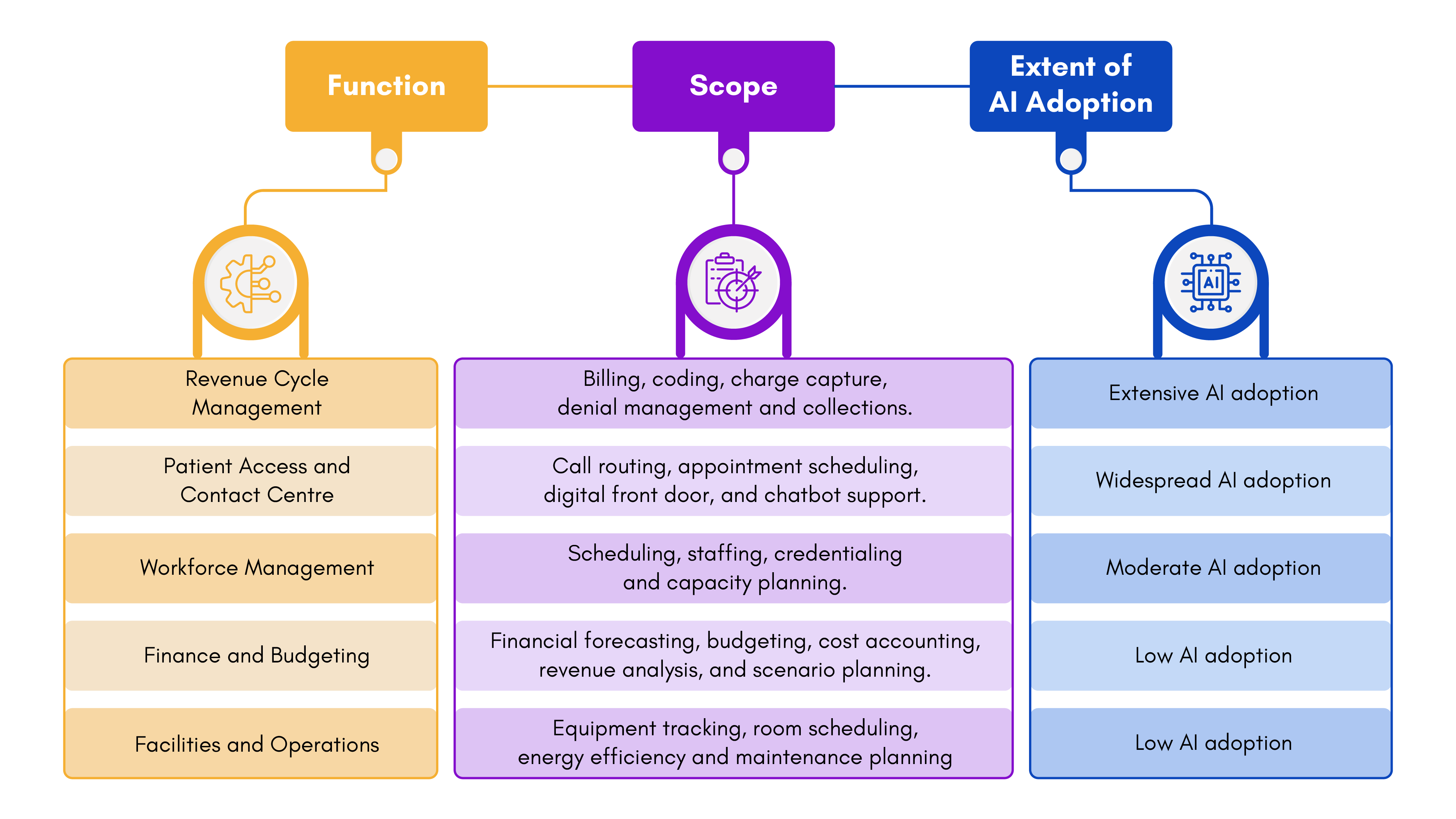
Revenue Cycle Management (Extensive AI Adoption)
AI first gained traction in Revenue Cycle Management, particularly in mid-cycle tasks such as coding automation, charge validation, and denial prediction. This was the most obvious place to begin, thanks to its structured data, repeatable workflows, and direct ties to revenue. It was easier to measure outcomes and justify the investment.
Since then, AI has slowly evolved to support both formal and informal processes across the entire revenue cycle. On the front end, automation now improves eligibility checks, prior authorizations, and patient intake. On the back end, complex processes such as denial follow-ups, payment reconciliation, and appeals are supported by discrete AI tools.
However, most of these tools still operate in silos. Each one is designed to optimize a single step with integration into the larger system. They rarely connect or share data with other tools or platforms. As a result, they fail to create a cohesive, optimized, end-to-end process. To unlock the full value of AI and build a cohesive revenue cycle, organizations must adopt a more comprehensive approach where insights and actions are linked across the entire revenue cycle. For example, by adopting AI-powered claim review solutions, California Healthcare Network was able to reduce prior authorization denials by 22% and cut denials for non-covered services by 18%.
Patient Access and Contact Centre (Widespread AI Adoption)
AI in Patient Access and Contact Centres was first implemented for tasks such as appointment scheduling, call routing, and benefits verification. These areas were the obvious starting points, given that they work with structured data, measurable and repeatable workflows, like faster onboarding and reduced waiting times.
Since then, AI has also been applied to enable chatbot assistance, automated prioritization, and proactive patient engagement. However, most AI tools in patient access and contact centres still do not support end-to-end processes. They remain disconnected, operating in silos without seamless integration.
Since then, AI has also been applied to enable chatbot assistance, automated prioritization, and proactive patient engagement. However, most AI tools in patient access and contact centres still do not support end-to-end processes. They remain disconnected, operating in silos without seamless integration.
For exmaple, The University of Arkansas for Medical Sciences used Luma Health’s AI-powered Navigator to automate 95% of after-hours calls, saving more than 800 staff hours each year and securely handling close to 10,000 calls through direct integration with its Epic EHR for tasks like appointment changes, follow-ups, and patient verification.
Workforce Management (Moderate AI Adoption)
Scheduling was one of the very first areas in Workforce Management to adopt automation. Tools were developed to predict no-shows and align shifts based on historical patterns of patient volume, staff availability, and absentee trends. This repetitive, data-driven, highly measurable task was a natural starting point for automation.
Since then, solutions have grown to include basic workload planning and shift coverage, but most workforce management tools still focus narrowly on day-to-day scheduling. Little progress has been made in automating more strategic workforce functions, including credential tracking, workforce utilization forecasting, burnout prevention, and professional development.
Unless workforce scheduling tools are connected to HR systems and clinical planning, their impact will remain limited. The opportunity ahead is to build an integrated picture of workforce management that will allow health systems to plan proactively, respond swiftly, and support teams in a holistic way. For example, Optimum Healthcare IT deployed AI-driven nurse scheduling technology in hospital units, which led to a 10-15% reduction in staffing costs and a 7.5% boost in patient satisfaction.
Finance and Budgeting (Low AI Adoption)
The adoption of AI in facilities and operations started with tasks like energy management and predictive maintenance. It began in these areas, as they rely on measurable outcomes like maintenance records, energy use and equipment performance.
However, more strategic financial functions like scenario planning and cost modelling remain in the early stages of AI use. These areas rely on data from different departments, often in inconsistent formats. Functions like scenario planning are particularly complex as they involve testing ‘what-if’ situations that depend on changing variables such as staffing, supply costs, and market shifts.
The road to mature AI adoption in finance requires accurate, consistent, and current data across systems. Clean inputs allow AI tools to better support ‘what-if’ analyses and long-range financial planning. Achieving this level of maturity depends on connected systems, standardized data formats, and disciplined data entry practices across the organization. For example, EXL Health implemented an AI-powered pre-pay bill review that helped a mid-market health payer save $1.8 million, reduce claim disputes, and improve operational efficiency.
Facilities and Operations (Low AI Adoption)
The adoption of AI in facilities and operations started with tasks like energy management and predictive maintenance. It began in these areas, as they rely on measurable outcomes like maintenance records, energy use and equipment performance.
AI is now also being used for tasks like smart building management, waste management, and space utilization analysis, which are safer to test since they don’t directly impact patient care. Most other use cases, like hospital logistics optimization, real-time infection control, and integrated safety analytics, are still in the early stages because they require consistent, high-quality data from multiple systems. To realize their full potential, hospitals need unified and standardized operational data so AI can allocate resources effectively, strengthen safety measures, and create optimized care environments.
For example, St. Vincent’s Hospital cut total energy use by 20% and reduced peak electrical demand by 10% after introducing BuildingIQ’s AI-powered Predictive Energy Optimization™ software, which adjusts HVAC settings in real time using data on weather, occupancy, and energy prices.
Solutions to Close the Gaps in AI Adoption Across Healthcare Functions
Bridging the gap between fragmented AI efforts and enterprise-wide transformation requires more than just deploying isolated tools. It demands an intentional strategy that aligns data, people, and processes to create a sustainable impact.
Where and How to Start?
The most practical entry point is at the source: data. Ensure that you collect all the operational data – whether from HR, finance, supply chain, or clinical operations in a standardized format, and store it on a unified platform.
The next step is to select one or more AI solutions that align with your data format and platform. Prioritize solutions that tackle high-value use cases and help improve processes and outcomes across departments.
The final step is to build a supportive framework: establish clear guidelines, train your team to work with AI tools confidently, monitor progress closely, and implement feedback loops to continuously refine system performance.
Applying the Framework to Key Operational Areas
Revenue Cycle Management
Revenue and billing information often originates from multiple systems – spreadsheets, legacy applications, or disconnected databases – each with its own formatting. This lack of standardization makes it difficult to get a clear, accurate view of the revenue cycle. Consolidating data onto a single platform with unified formatting is a critical first step.
From there, AI can be used to automate routine tasks like entering claim details, transforming unstructured clinical notes into billable codes, and predicting denials based on historical patterns. When these tools are integrated across the revenue cycle, they reduce manual work, minimize errors, and create a more efficient billing pipeline.
| Technology | Function | Solutions |
|---|---|---|
| Data Management Platforms | Consolidate and standardize data from various sources | Cloud-based healthcare data integration and normalization platforms |
| Robotic Process Automation (RPA) | Automate repetitive high-volume tasks like data entry and claims submission | Healthcare-specialized no-code RPA suites with built-in HIPAA compliance |
| Natural Language Processing (NLP) | Extract information from unstructured clinical notes and documents | Clinical NLP engines embedded in documentation and coding software |
| Predictive Analytics Tools | Analyze historical data to forecast claims at risk of denial | AI-powered denial prediction and reimbursement optimization tools |
| Workflow Orchestration Software | Synchronize AI applications across revenue cycle stages | Rules-driven orchestration platforms for end-to-end RCM process automation |
Patient Access and Contact Centre
The data that patient access and contact centres account for, in most cases, is maintained in different formats across patient records, appointment schedules, and call logs. Standardizing data into one consistent format for collection and maintenance is essential to ensure accuracy and efficiency across all systems, allowing for seamless integration and improved patient management.
Once all the given data is made available in one defined format, AI can then be used to automate tasks like appointment scheduling, verifying insurance and routing queries. In addition, AI can also be used to predict no-shows, improve decision-making, and optimize resource allocation by identifying patterns and trends in patient behavior.

Workforce Management
Workforce data resides in isolated systems such as scheduling apps, spreadsheets tracking certifications, and HR systems, making it difficult to build a cohesive view of staffing needs and capacity. Consolidating all workforce data on a unified platform enables smarter, AI-driven planning. Automated scheduling software can optimize shifts based on historical patterns and real-time inputs.
Credential tracking tools automatically remind managers about upcoming expirations, while analytics can detect early signs of staff burnout or understaffing. Linking workforce data to HR and clinical systems gives managers a clear and real-time view of their teams and helps them plan better.
Technologies Transforming Workforce Management Functions
| Technology | Function | Solutions |
|---|---|---|
| Unified Workforce Management Systems | Collect and centralize workforce data | Cloud-based workforce management platforms with integrated analytics and compliance tracking |
| Automated Scheduling Tools | Use past patterns and real-time inputs to optimize shift assignments | AI-driven scheduling software that adapts to changing workloads and availability |
| Credential Management Software | Track certifications and compliance deadlines automatically | Digital credentialing and compliance tracking systems with automated alerts |
| Predictive Analytics | Identify staffing shortages and burnout risks before they escalate | Predictive workforce analytics platforms that use historical and operational data to forecast risks |
| Integration Platforms | Connect workforce systems with HR and clinical data for a holistic view | Middleware and API-driven integration platforms for healthcare workforce ecosystems |
Finance and Budgeting
Finance data is often scattered across departments and captured in varied formats, which slows down budgeting cycles and leads to inaccurate forecasts. Bringing all finance data into a centralized system with a consistent structure allows teams to track spending in real time, detect overages early, and plan more effectively. AI-powered tools for scenario planning let teams test different budget options and prepare for changes.
When linked with supply chain, clinical, and HR data, finance leaders can align operational goals with fiscal planning.
Technologies Enhancing Enterprise Budgeting and Financial Management

Facilities and Operations Management
As seen in earlier use cases, data in facilities and operations is also maintained in different formats, making it difficult to gain a unified view and optimize performance. The first step here is to credentialize one format for data collection and maintenance, which is essential for ensuring consistency and enabling seamless analysis and optimization across systems.
AI tools can then be used to optimize resource allocation, automate routine tasks like logging and scheduling, and predict maintenance needs.
| Technology | Function | Solution |
|---|---|---|
| Facility Management Platforms | Centralize maintenance, inventory, and operational data | Cloud-based platforms for tracking assets, maintenance schedules, and inventory |
| Energy Management Tools | Monitor energy consumption and optimize usage | AI-powered energy management systems with real-time monitoring and predictive analytics |
| Predictive Maintenance Software | Forecast equipment failures and maintenance needs | AI-driven tools for predictive maintenance and asset lifecycle management |
| Workforce Management Systems | Manage staffing, shift scheduling, and resource allocation | AI-powered scheduling and resource optimization platforms for operations teams |
| Data Integration Solutions | Connect facilities data with enterprise systems (HR, finance, etc.) | API-based integration platforms to connect facility management with other business systems |
The Critical Role of Partnering with an Expert AI Service Provider
At this point, the opportunity is clear. But turning potential into performance calls for deep domain expertise. It also requires cross-functional alignment and a strategic roadmap that guides AI adoption at scale. Read further to dive into key factors to consider while choosing a partner to help you through this journey.
How to Choose the Right AI Implementation Partner
Healthcare Knowledge
Pick a partner with a deep understanding of healthcare operations, regulations, and workflows. They should have hands-on experience working with finance, staffing, billing, and clinical teams so they truly understand your challenges and can speak your language.
Support with Change
The right partner will guide your staff through the transition, ensuring smooth adoption of new tools and strong collaboration. They should have a clear change management plan to support their staff every step of the way.
Proof of Success
Ask for real-world examples where the partner has made a difference. Success stories from similar healthcare organizations can give you confidence and clarity.
Data Privacy and Security
Make sure your partner prioritizes compliance and safeguards your data with robust, healthcare-grade security measures.
Operational AI: Healthcare’s Quiet Revolution
To realize the full value of AI in healthcare operations, the focus must shift from scattered fixes to systemic intelligence. It’s not about having AI in many places but about making AI work cohesively across the enterprise. When revenue cycle, workforce, supply chain, and finance processes are no longer siloed but aligned through shared data and intelligent coordination, healthcare organizations can unlock new levels of efficiency, adaptability, and resilience. These connected insights can lead to faster decisions, better resource planning, and smoother patient experiences behind the scenes.
It’s a shift from reactive problem-solving to proactive, intelligent operations. Achieving this kind of orchestration requires more than just technology; it calls for deep healthcare understanding, thoughtful integration, and trusted collaboration with the right partner.
The opportunity now is not just to automate tasks, but to architect smarter operations that think and respond as one.