
White Paper
360 degree view of telematics in fleet management
An Intelligent Approach to Predictive and Consistent Quality for Enterprises
- By Hiten Shah & Anuradha M
Transportation and Logistics organizations need to focus on the integration of all functions, and convergence of processes. This requires contemporary telematics and other technical solutions, with the ability to not only automate and shorten processes but also improve safety, offering greater flexibility and reliability.
The term “telematics” comes from a blend of telecommunication and informatics sciences. Telematics refers to the use of wireless devices and “black box” technologies to transmit data in real time back to an organization. In automobiles, factory installed or aftermarket boxes collect and transmit data related to vehicle use, maintenance requirements or automotive servicing. Telematics can also provide real-time information on airbag deployments or car crashes and locate stolen vehicles by using GPS technology. In addition, telematics can serve as the platform for usage-based insurance, pay-per-use insurance, pay as you drive (PAYD) insurance, pay how you drive (PHYD) programs for fleet insurance, or teen driving programs.
Data collected by onboard devices is called telemetry. Telemetry is read-only data about the environment, usually collected through sensors. Each source of telemetry results in a channel. Telemetry data might be preserved on the device or in the cloud. Although each device might send only a single data point every minute, when you multiply that data by a large number of devices, you quickly need to apply big data strategies and patterns. For example, a highly intelligent computer in a vehicle that is able to report on nearly every detail –from speed and idling, to fuel use, tire pressure, and more, This can mean saving on maintenance costs by better monitoring of vehicles. It could also help to improve fuel efficiency by tracking driving habits. All of this describes the universe of telematics, also known as GPS fleet tracking.
How telematics works
Data collected by the telematics device, like the GPS position, speed of the vehicle, and the g-force measured by the built-in accelerometer, are sent in a packaged format to a data center. The data then gets decoded.
360 degree view of telematics
Taking a 360-degree approach to telematics, we have Sensors which perform the duty of capturing data. We then have the data from the sensors which is called Telemetry Data and finally, we look at the benefits of telematics.
Sensors
Heavy-duty vehicles have pervaded all areas of business from commercial trucking to agriculture and construction. These vehicles are not cheap and their maintenance costs can escalate up to 30 percent of a vehicle’s lifetime cost. As a result of this but also mainly to improve overall efficiency, truck owners are constantly looking at innovation to improve productivity and profitability.
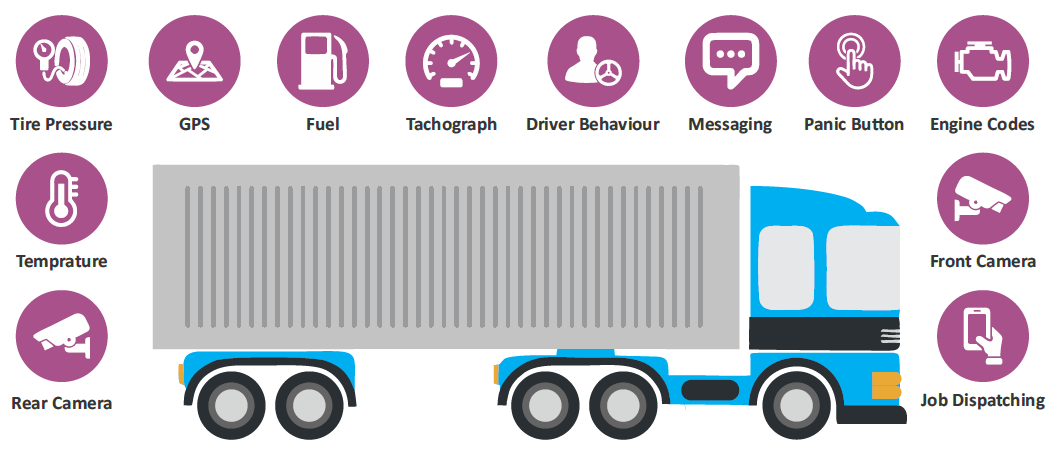
Telematics using sensors, which is a standardized set of hardware, is actively being used to track all aspects of a vehicle’s movement and performance. Telematics sensors can provide data on so many aspects of a vehicle. See image below:
Telemetry data
Sensors, as mentioned above, are devices. Collecting the data from devices and analyzing it is critical to improved user experiences, and to make informed business decisions.

The derived data from sensor devices called data sources is transmitted to data centers. Managing data transmission from point to point, and then integrating and analyzing data is the most important aspect of telematics
Often information can run into thousands of data points. This volume of incoming data can run into gigabytes of data per hour, just coming off a single vehicle. Given a fleet of large number of vehicles, the amount of data to be transmitted and processed can be tremendous. The massive amounts of data will drive some data governance and data quality issues that must be addressed at the data integration layer. Data is typically not validated when it is generated by a device, but it must be checked at some point. Moreover, the complexity of these systems means that the use of data governance approaches and technology are imperative.
Adding complexity to telematics is technology innovations such as connected vehicles, cloud infrastructure, IoT, and mobile computing. These innovations are driving visibility, automation, and optimization in the Transportation and Logistics industry. While government regulations such as Hours of Services (HOS), Compliance Safety & Accountability (CSA), Electronic Logging Device (ELD) are ensuring safety in the transportation industry, there is a mandated need to make necessary changes to the software and systems.
Key benefits of telematics
- Reduced claim costs
- Optimized productivity
- Fleet compliance
- Reduced out-of-route miles
- Improved driver experience, productivity, and reduced overall driver miles
- Fleet, driver and cargo KPIs
- Reduced emissions
- Manage maintenance schedules
- Real-time communication
- Improved CSA scores
- Remote diagnostics and reduced fleet risks
- Improved fleet performance and schedules with proof of delivery
- Reduced downtime
- Reduced fuel consumption
Role of telematics in revolutionizing fleet management
Telematics has become a crucial technology for fleet management. Telematics supports these five core areas:
- Productivity and improved customer service by using real-time GPS tracking, trip reporting, and dispatching and routing tools. Read our customer success story here
- Safety with the availability of in-vehicle driver coaching, risk and driver behavior reporting, accident notifications and reconstruction, and the ability to locate a stolen vehicle. Read our customer success story here
- Optimization of vehicle maintenance with predictive maintenance abilities and remote diagnostics, and optimization of fuel management by tracking idling and other fuel-guzzling habits. Read our customer success story here
- Compliance with solutions for electronic logging and Hours of Service, IFTA reporting, and vehicle inspections. Read our customer success story here
- Integration of other software systems such as onboard camera technology or CRM software. Read our customer success story here