
It all began with staring at a piece of paper and wondering man, wouldn’t it be a lot easier if this was all on a spreadsheet that we could use and edit together!
That aha moment sparked him to compose some macros and design an Excel sheet that would go on to become the company’s defacto operating system for the next three years.
He eventually moved out of the company, but the plant grew in scale, inviting new machines. Yet the factory’s workflow ran on a stack of excel sheets, with the original spreadsheet being the master of them all.
And then one fine day, a new employee accidentally made an error and saw their sheets go haywire. It was a moment of reckoning for the leadership as they realized it was not just the sheets, but the entire factory had come to a standstill.
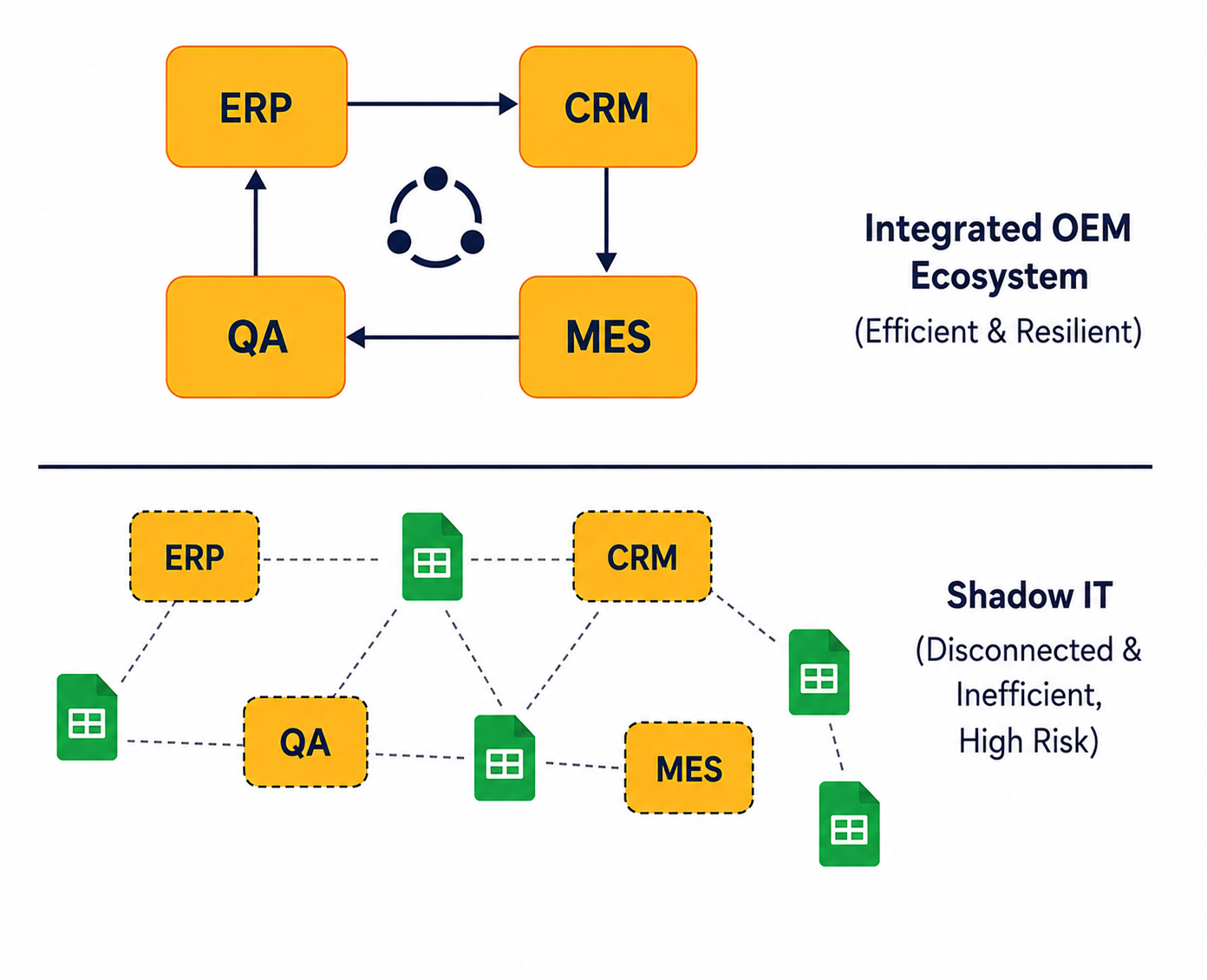
Cut to a few more years, where the factory was now running on a series of OEM softwares across resource planning, production scheduling, inventory optimization, and warehouse management. Yet beneath these expensive OEMs were born-again spreadsheets, lurking in the shadows, quietly pulling the strings of the business.
The effects of shadow IT soon become obvious:
1 A machine went down at 9.00 in the morning. The production scheduler, unaware of the development, had already scheduled a job in their spreadsheet for that machine.
2 An operator had forgotten to log a downtime event. The format to enter downtime reasons were inconsistent across plants.
3 The job was scheduled, but a raw material shortage had stalled the run.
4 Critical issues from previous shifts get lost in long spreadsheet comments. Shift teams continue production without taking stock of unresolved maintenance issues.
5 Different plants use different metrics to compute operator productivity.
There were a multitude of issues that began to creep across the factory floor all pointing to one singular factor: The data in the spreadsheets were not reflective of the floor realities.
The leadership immediately opts for an overhaul, this time seeking the help of a system integrator to customize the ERP and MES systems to suit their business workflow.
But the customization induces inefficiencies of a different order. For every vendor upgrade, The custom core had to be rewritten and retested, failing which exposed the organization to serious security vulnerabilities. Further customization resulted in the need for specialized IT skills rather than standardized IT resources. Sooner than the later, the leadership observes the vendor lock-in had been cast, for the company is wholly dependent on the deeply customized OEMs, whose annual maintenance costs outweigh its benefits. At this point, disgruntled with the convoluted systems, someone began to start up a spreadsheet.
This is the vicious cycle of Shadow IT across three Manufacturing archetypes: Fragmenters, Evaders, and Clingers.
| Fragmenter | Evader | Clinger |
| Manufacturers with a fragmented IT landscape. Data pools scattered between disconnected legacy applications | Manufacturers with underutilized OEM systems. Spreadsheets act as the unofficial operational infrastructure | Manufacturers with deeply customized OEM systems. Immense customizable debt. |
Fragmenters
A study shows that more than 85% of manufacturers run their entire workflow on a patchwork of excel sheets, paper logs, monolithic applications, and tribal knowledge. But most of these manufacturers’ business have outgrown the botched systems in place. Now they are caught with a dilemma as to whether they should jump into full-blown rigid OEM systems or contend with existing spreadsheet-driven IT, rampant with scattered data and manual workflows. Added to this, the question of how to infuse AI confounds them. Because AI is increasingly seen as a lever to counter elevated input costs and persistent inflation, fragmenters are actively exploring AI-powered manufacturing IT services to steer their business towards organizational efficiency and resilience.
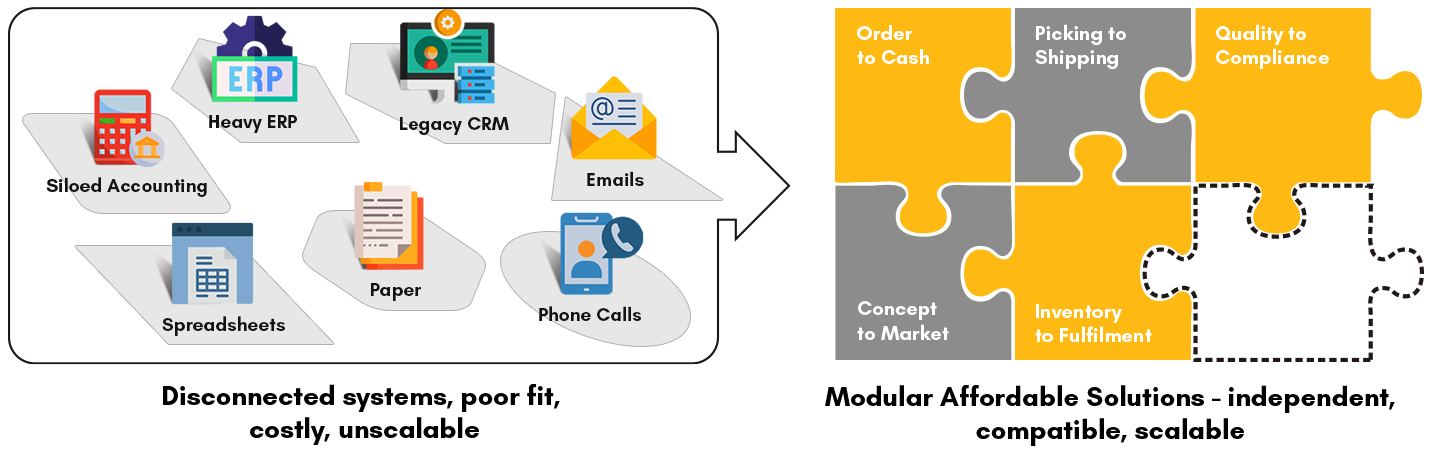
How Trigent’s Prebuilt Modules Modernized a Fragmented ITscape.
The fragmenter in question was a health and wellbeing manufacturer, whose business operations was progressively transformed with a series of low-disruption fixes. The monolithic order management system was replaced by a prebuilt order management module that allowed adding users, updating prices, and managing promotions on the go. Bulk-ordering was enabled through an excel-style interface. A similar transformation was seen in order picking where the pickers were smartly guided by a mobile application suggesting the shortest route for picking. It also ensured that only the correct items were picked. In a similar fashion, an inventory-fulfillment module rejuvenated warehouse management, enabling batch, lot, and zone tracking. Thus the fragmented IT landscape had become a cohesive, connected ecosystem, which steered the business to operate at an optimal time, cost, and effort.
Evaders
Evaders have already invested in off-the-shelf software for their manufacturing functions across production, inventory, warehouse, quality and maintenance. However managing these processes within the traditional OEM interfaces tends to be tedious. Data alterations, back and forth email exchanges, and approvals often happen outside of these OEMs. Most business teams are comfortable in importing data from the OEMs, performing data manipulations in Excel, and exporting data back into the OEM software. Thus OEMs act as systems of record, while spreadsheets are the systems of action. But this parallel processing was not without consequences.
It introduces 3 major hurdles:
- Firstly, a significant human effort is required to ensure that the spreadsheet remains current.
- Constant manual entries introduce errors. Even a decimal slip can spell major troubles.
- Different teams working in their own spreadsheets induce major data latency, hindering the ability to anticipate problems and act in real time.
Most of the evaders are conscious of the shadow IT issues. They are keen on standardizing workflows around OEMs through Manufacturing AI integration services so as to optimize for greater efficiency and resilience.
Trigent Powers an Evader to Unlock Value from its SAP investments
The Laser tool manufacturer had made significant investments in the SAP ecosystem. Additionally non-sap modules and bespoke applications were in the mix supplying data to a centralized SAP HANA data platform. But reporting and analysis were done in a decentralized fashion, with some teams employing SAP business objects and others relying on excel. Each team followed their own definitions of KPI and metrics, which was inconsistent with the enterprise logic. This obstructed in paving the way for both SSOT (single source of truth) and SVOT (single version of truth). As part of its AI manufacturing transformation services, Trigent enabled a seamless migration from SAP HANA to SAP Datasphere, unlocking a federated self-service model that saw business teams creating their own reports anchored in a common unified enterprise logic. Access to insights was much faster with little to no dependency on the IT team. On top of these, Trigent optimized model-level optimization that ensured superior performance yet lower TCO.
The simple and seamless migration saved $175K annually, unlocking greater cash flows for the company.
Clingers
The clingers are known for their huge customization debt. They are locked within deeply customized architectures. These could be bespoke applications built from scratch or proprietary OEM systems reengineered and force fitted to reflect the legacy workflows. Most of the companies face scalability issues, since the customized core has diverged from the original product, increasing its technical complexity and making future updates and scaling difficult. The clingers’ expectations are a scalable standardized core surrounded by modular workflows that enables them to be resilient and adaptive to changing market conditions—an area where Manufacturing AI integration services are increasingly shaping modernization strategies.
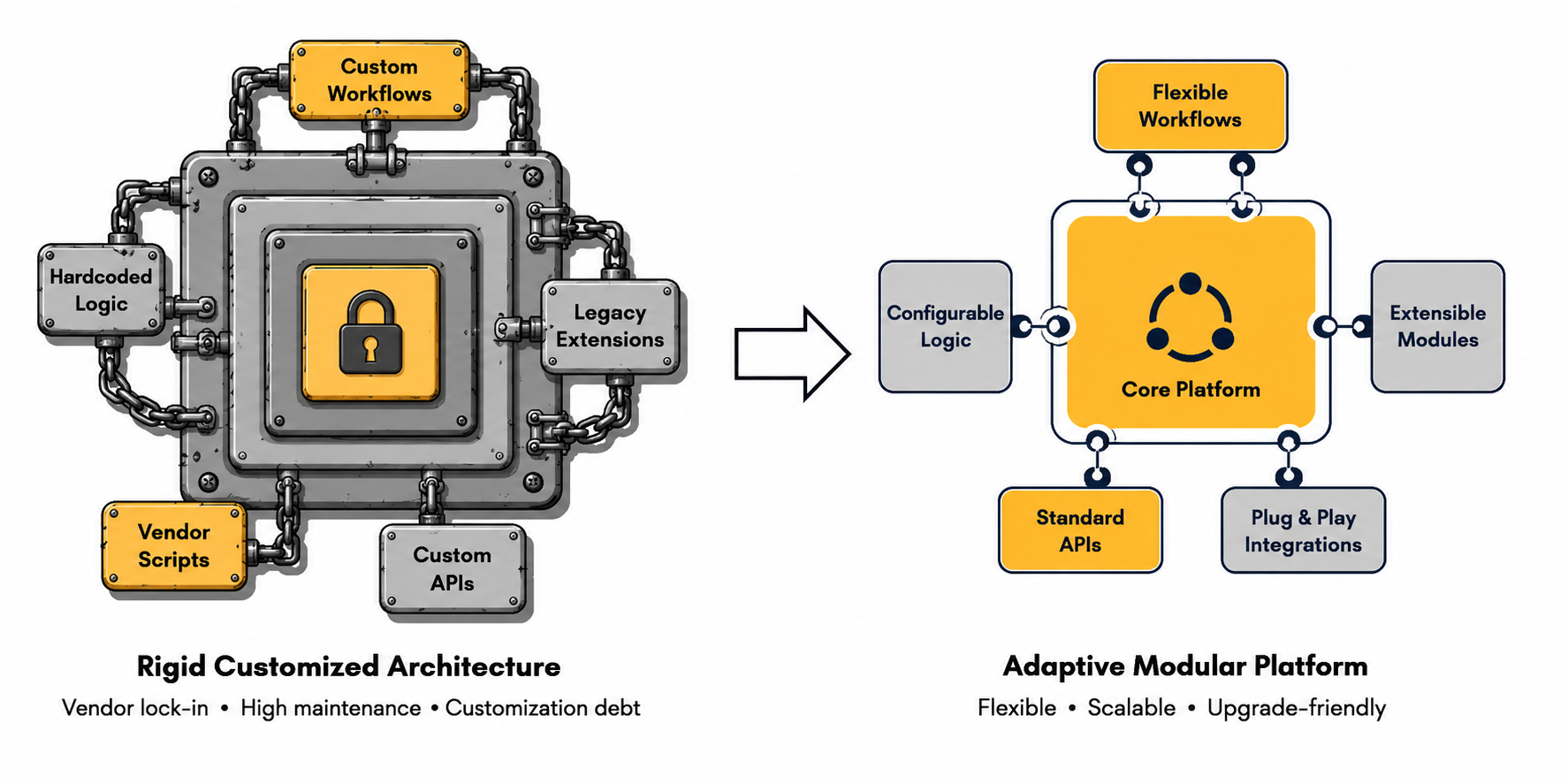
Global Truck Manufacturer Accelerates its Design Cycle Time through a Modular Solution
The manufacturer was using a third-party software to manage its parts information, including the data on supplier, components, and designs. With new truck specifications coming in frequently, the systems struggled to cope up with the increasing catalog and configuration rules. Since the software had already gone through extensive customization, any modifications to the system required considerable time and effort. Trigent suggested a bespoke application using a proprietary low-code solution. The cost of the custom development was still lower than the annual maintenance cost of the software. Also, advanced search capabilities were enabled in the new system, which saw users easily retrieve complex information related to the parts. This instant access to information accelerated design cycle time, enabling the manufacturer to launch variants faster and address market demand—one of the key outcomes manufacturers increasingly expect from AI manufacturing transformation services.
Riding the Tariff Turbulence with Trigent’s Manufacturing Transformation Services
The fragmenters, evaders and clingers are unanimously affected by the tariffs hitting close to 12%. This has resulted in an elevated raw material costs, now averaging 4.4%. All of these three manufacturing archetypes face one common question: How can we extract greater efficiencies from our existing assets without breaking what already works.
This is where Trigent’s AI-powered Transformation services shows its prominence. For a fragmenter, its prebuilt yet customizable modules offer a phased approach to transform its fragmented IT landscape into a connected, cohesive ecosystem. For evaders, Trigent’s services centers on optimizing its existing OEM workflows. For a clinger, the focus is to transform its rigid architecture into a scalable, modular system built for future-proof agility.
Modernize Your Manufacturing Operations
