Until May 2025, Net Zero Logistics was sending 30 to 40 vans onto Connecticut roads every day. Its transportation management software could record shipments, track activity, and handle the routine duties expected of a TMS. But, it fell short of what CEO Mark Chiusano wanted from it – identify routes that lowered cost without breaking service commitments. The existing platform simply couldn’t get there.
So the company layered in Finmile, a dynamic routing engine that factors in traffic, weather, service-level agreements, vehicle specs, driver behavior, and who’s actually available that day. The daily route count fell to somewhere between 16 and 20, while drivers delivered the same volume of packages, often more. Package sorting sped up, too. Instead of sorting freight by hand before sunrise, drivers scan a package, and the software tells them which route and tote it belongs to.
None of that came from replacing the TMS. It came from admitting the one Net Zero already had wasn’t built for how the business actually needed to operate, and building the missing piece around it instead of waiting for a vendor roadmap to catch up.
That distinction, a system that technically works versus a system that fits, tends to vanish during transportation technology evaluations. A selection committee compares features, sits through demos, argues over cloud architecture, and asks every vendor whether the platform integrates with the ERP.
Then the implementation meets the actual freight operation, and the demo stops being the point. The plant outside Houston handles things differently from the distribution center in New Jersey. A dealer network working out of Miami allows split shipments; a customer in New York slaps on a chargeback the moment you sneeze wrong. A carrier accepts a load and sends a driver with the wrong trailer. Finance disputes an accessorial that operations approved over text three weeks ago, in a thread nobody can find.
On the highway, a tractor hauling an empty trailer is “moving air.” In many logistics organizations, the software equivalent is moving data without moving the decision. The system records what happened. Figuring out what happens next still falls to a planner, dispatcher, carrier rep, plant manager, or customer-service agent working the phones.
This is where custom TMS workflows earn their keep. Not because every company should build a transportation management system from scratch, and certainly not because every regional quirk deserves its own feature. Customization makes sense when a workflow is commercially important, operationally unusual, integration-heavy, hard to standardize, or costly to fail. The real questions are more precise than “build or buy”: Who genuinely needs custom transportation workflows? What should be customized, and what should stay standard? And how do you build the right level of capability without creating the legacy system everyone complains about in five years?
What Is a Custom TMS Workflow?
A custom TMS workflow is a company-specific sequence of data inputs, decisions, validations, approvals, system actions, communications, and exception paths.
In practice, this is what most transportation management system development actually is: not a rebuild from zero, but the work of shaping how an order becomes a shipment, which carrier gets the tender, what happens after a rejection, how an ETA gets calculated, who approves premium freight, what counts as an acceptable proof of delivery, and how the final charge lands on the general ledger.
The TMS screen is only part of that machinery. The workflow may also touch an ERP sending demand data, a WMS confirming pickup readiness, a supplier portal scheduling an inbound collection, a routing engine weighing consolidation options, a carrier API or EDI feed communicating the tender, a telematics platform reporting vehicle events, a visibility provider calculating an ETA, a customer portal publishing status, a freight-audit process validating charges, and a human approver resolving whatever’s left over.
Custom doesn’t have to mean code everywhere. In a well-designed system, ample variation can be managed through configurable rules, reusable components, APIs, decision tables, event triggers, and role-based interfaces. The goal is to stop the company’s most important workflows from getting bent out of shape to fit a vendor’s generic assumptions.
Where One-Size-Fits-All TMS Workflows Break Down, and Who Feels It Most
Commercial TMS software is built around common transportation patterns: orders enter, loads are planned, carriers are selected, shipments are tendered, tracked, delivered, audited, and settled. That standardization has real value; nobody needs custom software commissioned every time a bill of lading is generated. The trouble starts when common gets mistaken for universal.
A workflow can change by plant, customer, mode, region, product, equipment class, carrier agreement, or exception severity, and even inside one company, the happy path can be perfectly standard while all the commercially important work happens in the deviations. Generic processes tend to snap in the same few places.
Inbound and supplier coordination. An OEM workflow needs more than “shipment created, carrier assigned, delivery tracked”; it needs to know whether a delay threatens a production run, not just an inconvenient Tuesday afternoon.
Yard and dock handoffs. Arrival at a facility isn’t the end of execution, and when the TMS, yard system, and plant application don’t share context, the truck idles at the gate while receiving has no idea which dock is expecting it.
Carrier tendering and capacity. A static rate-based waterfall overlooks what real carrier selection weighs: acceptance rates, equipment availability, driver hours, and the cost of a missed appointment relative to the lowest contracted rate.
Exception management. It is for systems to throw an alert, but it gets interesting when it comes to orchestrating a response. An ETA slips, a carrier rejects a tender, a driver misses a delivery window, a document fails validation, and the system fires off a notification, maybe several, while the organization still has to work out who owns the issue, how serious it is, what it’s allowed to spend to fix it, and when it counts as resolved. In its 2025 supply chain technology survey of nearly 500 professionals, ABI Research found that 65% of respondents ranked a lack of clearly defined standard operating procedures among their top three barriers to acting on real-time data, the missing path from information to action, exactly the gap a well-built custom workflow is supposed to close.
Freight audit and settlement. Real transportation charges rarely match the base rate: detention, demurrage, fuel, stop charges, and lumper fees all get layered on, and when financial rules are disconnected from operational events, every invoice becomes a research project.
Customer, supplier, and carrier collaboration. Suppliers, carriers, dealers, and customers all need something different from the same shipment: confirmation, documents, an ETA, and proof of delivery. A single generic portal rarely serves all of them well.
Not every company hits these limits hard enough to justify custom work. A business with predictable volumes, a small carrier base, and standard customer requirements usually does well with an off-the-shelf TMS and an ordinary configuration. Complexity has to be fundamental to the business, not accidental. OEMs and manufacturers feel the inbound and yard problems hardest, since a late truck can stop a production line.
3PLs and managed transportation providers experience gaps in tendering and collaboration, since each client wants a different routing guide and portal. Freight brokers feel the pressure from exception management and pricing the hardest, since the market moves by the hour. Specialized operators, cold chain, heavy haul, hazmat, white-glove, see it as a risk rather than an inconvenience. And companies building an entirely new logistics product often find no off-the-shelf platform supports their model in the first place.
Why This Matters Now in the US Market
Logistics isn’t waiting for a quiet stretch to go tidy up its systems. The 2026 State of Logistics Report, authored by Kearney and presented by Penske for CSCMP, put the mood plainly. “Normalcy is not coming back,” said Ford’s head of North American transportation at the report’s release. US business logistics costs totaled $2.4 trillion in 2025, or 7.8% of GDP, and the report frames the current environment as structurally volatile rather than a temporary rough patch: tariff policy that changed on average every 1.5 weeks in 2025, tightening capacity, and trade lanes that reroute on short notice.
That has a direct implication for workflow design: transportation management software needs to accommodate change, not just automate last year’s network. Tariffs shift sourcing. A new customer imposes a different service window. A carrier drops a lane. A rigid system turns every one of those into a project. A flexible one lets the business revise a rule, add an integration, or stand up a new workflow without having to reopen the whole platform.
That volatility also looks different by region, and generic transportation software tends to treat the whole country the same way. A petrochemical shipper running heavy-haul out of Houston is managing a different risk profile than a distribution operation operating the ports around New York and New Jersey. A company routing freight through Miami into Latin America is watching an entirely different set of trade rules than either of them. Software built around one national average ends up managing none of them particularly well.
This is also why AI alone can’t rescue a poorly designed transportation environment. Descartes’ 9th Annual Global Transportation Management Benchmark Survey, covering more than 600 shippers and logistics providers, found that 96% are now using generative AI in their operations, with use leading in data entry, route and load optimization, and freight forecasting. And yet only 17% describe their transportation management as fully automated. That gap, sky-high adoption next to a fraction of it actually running end to end, is what you get when AI gets bolted onto workflows that were never built to hand it clean data or clear authority to act.
Read More: A Cloud-Based TMS Company Enhances its Security and Performance Through Test Automation
What Companies Get Wrong About TMS Customization
More features will solve it. Two platforms can both list routing, tendering, and exception management, and still differ completely in how easily rules change and how gracefully integrations recover. The real question isn’t “does it have exception management?” It’s “what happens after a high-priority shipment misses its plant window.”
Every unique process deserves to be preserved. Some workflows are distinctive because the business is. Others are distinctive because two departments never agreed on a standard. Before automating anything, check whether the variation is necessary, contractual, regulatory, or just a habit nobody’s questioned.
Custom means flexible. A poorly built custom system can be more rigid than the platform it replaced. Hard-coded rules turn every rule change into a release, and every release into a chance to break billing in three states at once. Flexibility comes from modular services and configurable rules, not from the word “custom.”
AI can compensate for a weak workflow. AI can predict delays and hold a routine conversation. It can’t fix contradictory rules, unclear ownership, or bad source data. An AI assistant producing the wrong freight rate in sixty seconds isn’t efficiency; it’s a faster margin leak.
Read More: Maximizing Fleet Efficiency and Driving Sustainability for PFNZ
How to Decide What to Customize
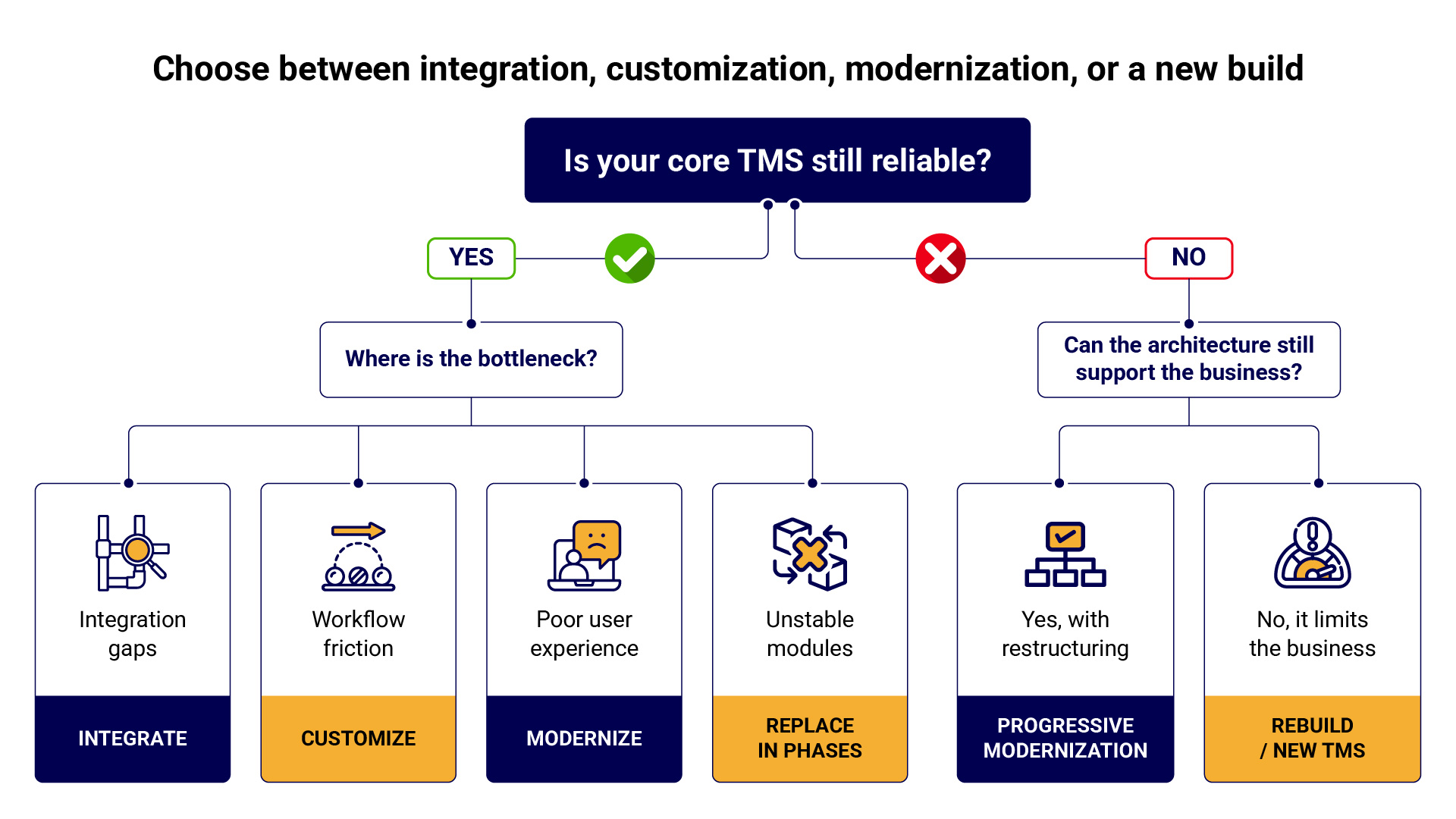
A useful framework runs through five questions:
- Does the workflow move service, margin, or customer retention (business differentiation)?
- Is it high-volume with manual friction, or low-volume but high-stakes if it fails (in terms of frequency and risk)?
- Does it change often enough by plant, customer, or lane that hard-coding it would be a mistake (variability)?
- How many systems and organizations does it touch (integration intensity)? And what happens if it makes the wrong call?
- Does it need automation or a human in the loop (decision authority)?
A routine low-cost tender can run itself. A premium move tied to a production stoppage probably shouldn’t.
What Should Be Customized, and What Should Stay Standard
The goal is to bring in customization where it actually pays off. The Tri TMS framework treats transportation management system development as a set of six capability areas that can be adopted as individual building blocks, bolted onto an existing system, or assembled into a broader bespoke platform.
A company with strong order and dispatch capability might need only better carrier connectivity and exception handling. Another might keep its core and replace the customer portal, mobile experience, or billing workflow. A freight-tech startup might use standard building blocks for documents and settlement while pouring its engineering budget into the one capability that actually differentiates the product.
| Your Need | Tri TMS Option | How It Works | Business Value |
| Add capabilities to differentiate your off-the-shelf TMS | Select from a catalog of add-ons | AI-augmented pricing, automated document validation, real-time transportation pricing, reverse logistics, and more | Innovate independent of the vendor’s roadmap; build a USP that helps retain customers |
| Modernize the TMS stack without disrupting the business | Progressive modernization | A modern web and mobile layer wraps the existing core; swap components without disrupting ops | Balance modernization with protecting existing tech investment, lower risk than rip-and-replace |
| A new business idea that off-the-shelf TMS doesn’t natively support | Assemble a bespoke TMS | Jump-start the build with standard workflows for shipments, orders, pricing, visibility, and billing | Logistics domain expertise built in; faster time-to-market on an idea built around the business, not a vendor’s assumptions |
Key Capability Areas
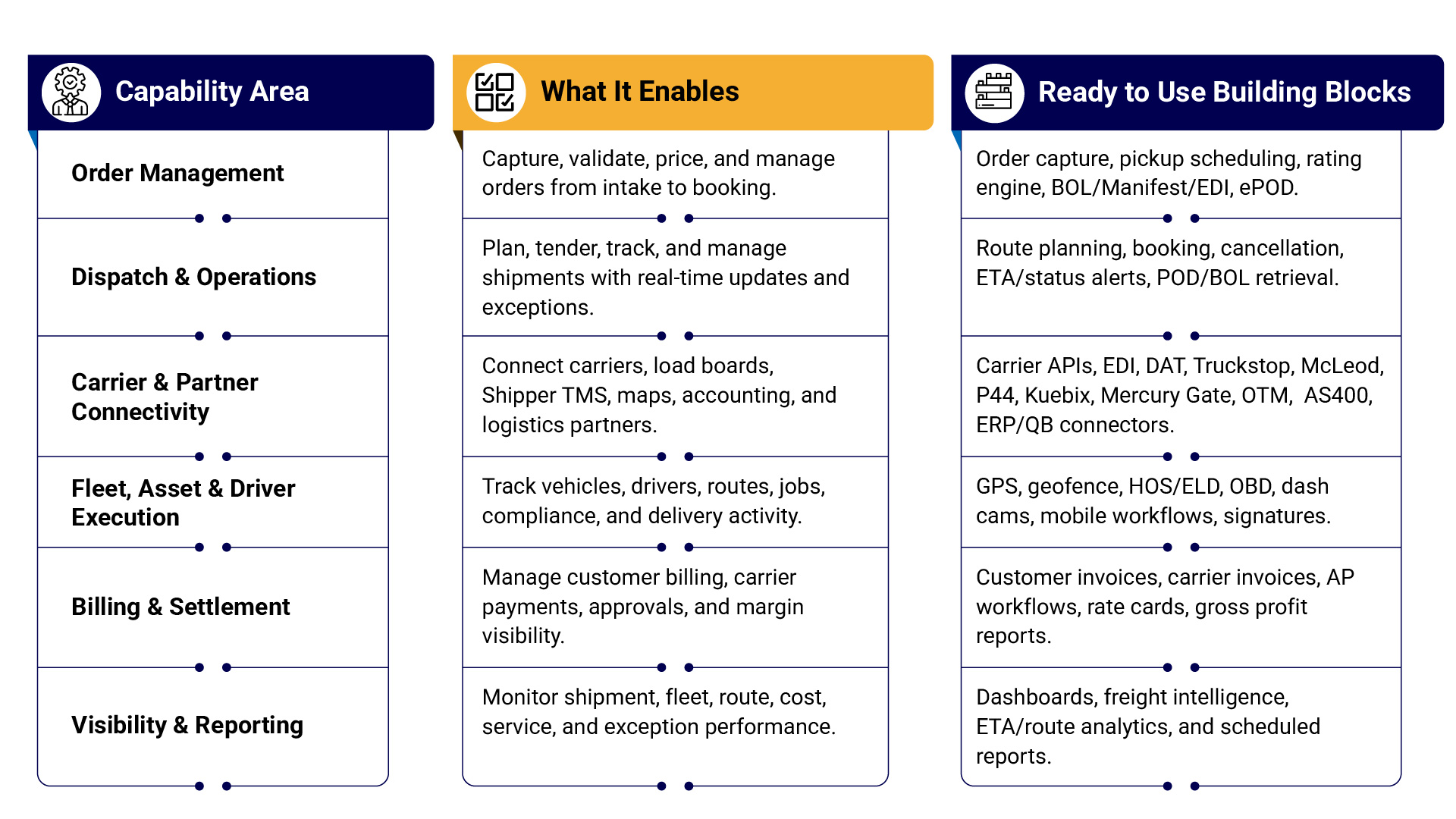
More than seven in ten respondents in ABI Research’s 2025 survey called interoperable, standardized APIs an important factor in vendor selection, which tracks: the whole point of a building-block model is that the pieces actually talk to each other and to whatever legacy system is still running the core.
| See the TMS building blocks and adoption options. Explore the capability areas for order management, dispatch, connectivity, fleet execution, billing, and visibility. |
These paths aren’t mutually exclusive, either. A company might add an intelligent quoting module this year, modernize the dispatcher and customer interfaces next year, and gradually replace legacy core services once the new pieces have proven themselves. The architecture should follow the business case.
How AI Assistants Extend the Workflow
AI in transportation earns its keep when it’s attached to a defined task, not floating around as a demo. Uber Freight’s own data shows empty miles on its brokerage platform fell from 25% of total miles in 2023 to 22% in 2024, an estimated 4 million miles, driven by load bundling and network intelligence that help carriers find backhaul opportunities instead of driving home empty. That’s the model: AI wired into a specific decision, backed by clean data, not a chatbot bolted on the side.
Trigent’s logistics AI assistants follow the same logic. They’re built around the conversations that interrupt dispatchers, planners, warehouse teams, and finance staff all day long:
- Jason handles freight quoting, comparing live carrier rates, and applying pricing rules on the spot.
- Elena covers shipment status and walks through exceptions using live operational data.
- Rick fields warehouse-scheduling questions, dock availability, temperature zones, and inbound and outbound windows.
- Claire retrieves PODs and BOLs, validates documents, and flags discrepancies.
- Jake handles carrier and driver check-ins, ETAs, and detention tracking.
- Laura explains invoice charges, validates accessorials, and initiates billing disputes.
But the conversational layer is only what’s visible. Jason can’t produce a sound quote without accurate shipment data and real margin rules to back it up. Elena can’t explain an exception if the event feed is running late. Laura can’t validate an accessorial if the contract and the timestamps disagree. Before turning one loose, it’s worth nailing down which system supplies the source data, what the assistant can complete on its own, when a human has to step in, and how the results get measured.
| Try Trigent’s AI assistants for freight quoting, shipment status, warehouse scheduling, document retrieval, carrier and driver coordination, and billing. |
Building It Without Creating Tomorrow’s Legacy System
Start by mapping the operation as it actually runs. Watch what happens when an appointment changes, a tender gets rejected, or a customer calls in hot. Then separate genuine differentiation from organizational folklore: does the variation protect service, margin, or safety, or does it exist because the business inherited a workaround and never removed it?
For every workflow that matters, define the decision before designing the screen: the trigger, the rule, who owns the call, and how success gets measured. Built in complete slices, one plant, one customer group, one exception type, end to end, rather than several unfinished layers waiting to be wired together later. Test the ugly cases on purpose: missing data, carrier rejections, API outages, conflicting rules, peak volume. The exception isn’t an edge case when it shows up like clockwork every Thursday at 4:45 PM.
Roll out in phases, and put someone in charge of governing the rules after launch, or the custom platform slowly turns into the next inflexible legacy system everyone complains about. And measure adoption, not just delivery. A workflow that’s technically complete but routinely bypassed by the team hasn’t actually shipped.
Choosing a Development Partner
Whether you’re evaluating an in-house build or a custom logistics software development company, the same test applies: does the partner bring more than engineering headcount? Look for logistics fluency, someone who understands routing guides, accessorials, detention, PODs, BOLs, and carrier onboarding without needing it translated.
Look for architectural judgment, a partner willing to say “keep this standard” and “don’t automate this yet,” not just “yes, we can build that.” Ask specifically how their development team handles integration failures, retries, and reconciliation, “We do integrations” is too vague to mean anything.
And ask how delivery gets measured, a development plan that tracks only sprint velocity and release dates misses the point; the real test is what happens to cost per shipment, tender acceptance, and exception-resolution time after launch.
Start With the Workflow Everyone Complains About
Most organizations need to look hard at the premium-freight approval that eats three hours, the tender that requires six phone calls, the customer status request that interrupts a dispatcher mid-shift, or the legacy screen that only one person on the team actually knows how to run. Pick one. Follow it from the first signal to the final outcome. Count the systems, the handoffs, the manual decisions.
A TMS should standardize the work that benefits from consistency, accommodate the work that genuinely differs, and when a load goes sideways, as loads occasionally do, help the business make a decision instead of just recording the wreckage.
| Find the right TMS path for your operation. Whether that means targeted capabilities, system integration, progressive modernization, AI-assisted workflows, or a bespoke build, Trigent’s logistics engineering team can walk through the options against your actual workflow. |