A TMS that nobody loves but nobody wants to shut down. Loads still tender. Invoices still go out. But dispatchers keep spreadsheets open beside it, customers call for status updates that the system should already have answered, and adding a carrier integration requires someone who remembers an EDI mapping built years ago.
Age isn’t what made it legacy. 68% of IT decision-makers say legacy systems are blocking their adoption of modern technology, and 48% keep them anyway because they’re still business-critical, per a 2025 survey of over 500 IT leaders. A system stays in production because it works, not because nobody noticed it’s old. The real question isn’t “how old is this.” It’s “where, specifically, is it failing.”
That distinction matters as transportation becomes increasingly strategic. Descartes’ 2025 benchmark of more than 600 companies found that 81% viewed transportation as a competitive differentiator, yet only 17% reported fully automated processes. More than a third still relied heavily on, or mostly relied on, manual processes.
The modernization question, therefore, is not simply, “What new TMS should we buy?”
It is: Which part of the current transportation environment is actually holding the business back?
Where Is Your TMS Really Breaking?
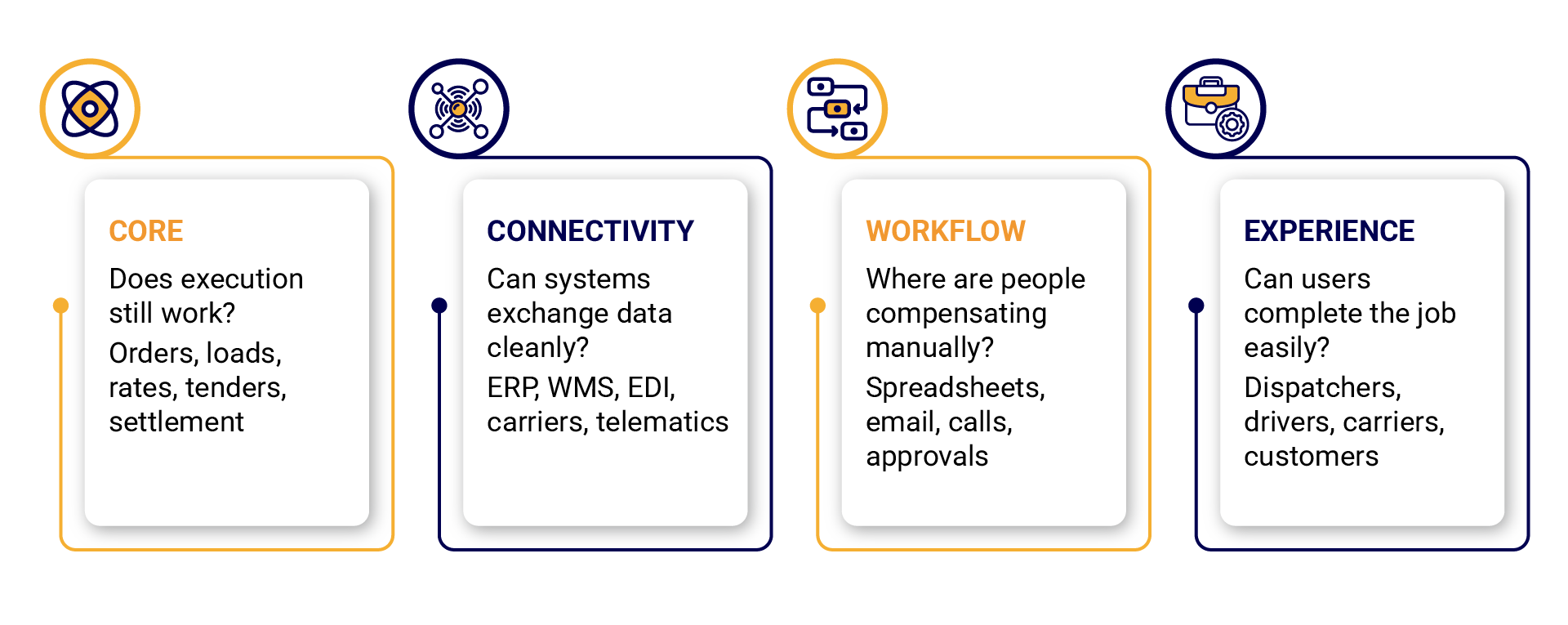
Typical symptoms include fragile integrations, spreadsheet workarounds, poor customer or dispatcher experiences, slow carrier onboarding, duplicate data entry, limited APIs, difficult reporting, and business rules buried in code.
At that point, companies generally have four areas to examine:
Fix the bottleneck, not the whole TMS automatically.
This diagnostic helps separate a platform problem from an integration, workflow, or experience problem.
What Should You Keep, Replace, Integrate, or Build?
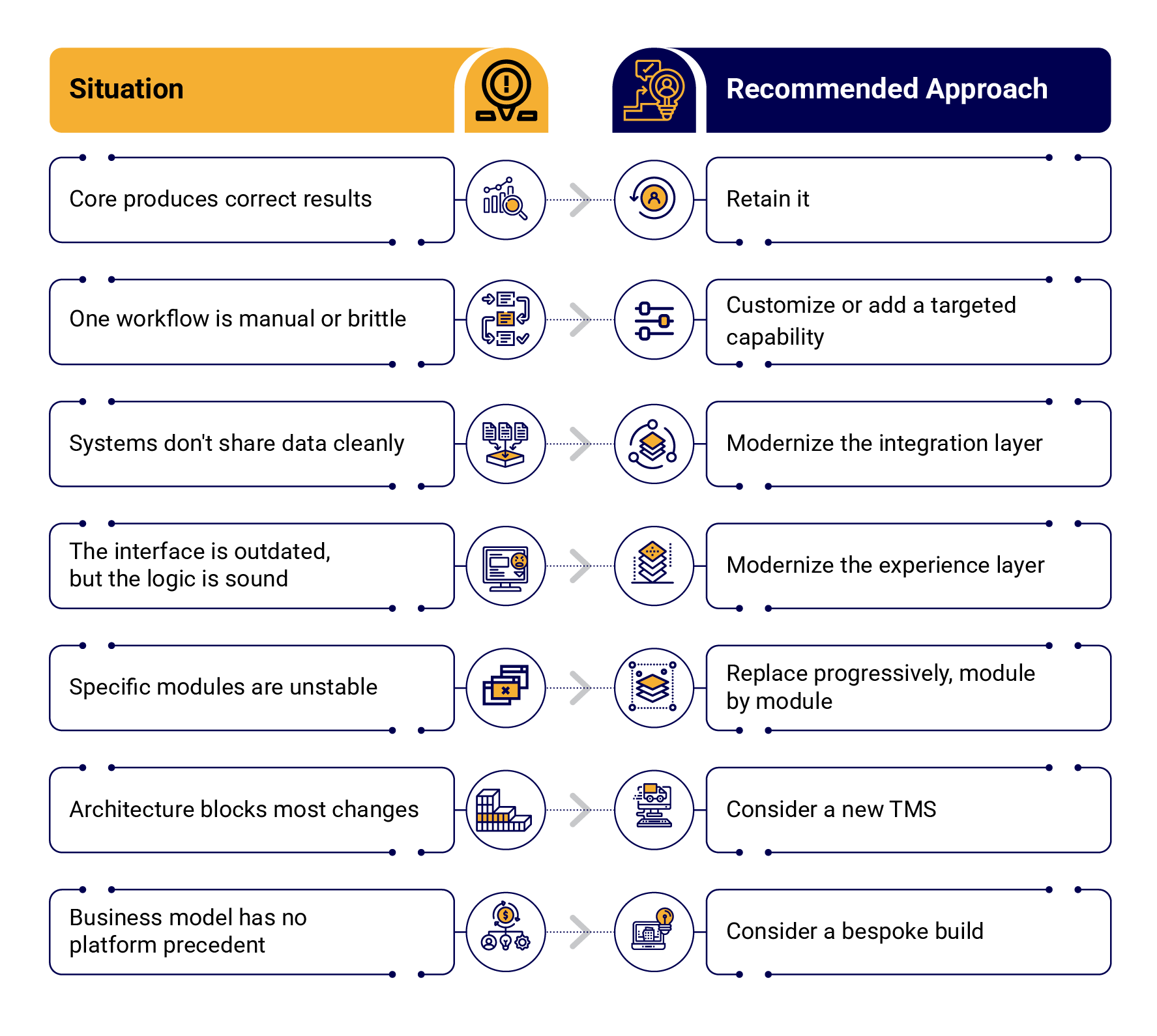
This is also the premise behind Tri TMS. Rather than requiring companies to adopt an entire platform, the model supports targeted capabilities, integrations, progressive modernization, or a bespoke TMS depending on what the business actually requires.
For example, a company could retain its current transportation core while adding better carrier connectivity or automated document validation. Another could introduce a modern dispatcher interface and later replace selected legacy modules. A new freight-tech business might begin with standard shipment, pricing, visibility, and billing components and develop its differentiating workflow around them. The Tri TMS model explicitly supports full-platform, module, and integration-based adoption.
| See which TMS modernization route fits your operation. Download the Tri TMS Flyer |
Progressive Modernization, Not Rip-and-Replace
In September 2025, LTL carrier Ward Transport & Logistics didn’t replace its TMS to fix slow, error-prone rating. It integrated a rate engine from Carrier Logistics directly into the platform it already ran. “Accurate rating is mission critical for LTL carriers,” said Mike Zupon, the carrier’s VP of technology, noting the change let the team handle more rate requests and stop losing shipments to slow quotes.
That’s the model: fix the specific layer that’s broken, leave the rest alone. It also avoids the cost most teams underestimate: a TMS license is typically only 20–25% of the total cost of ownership; the rest is integration work, and Oracle and SAP TM implementations commonly run 12 to 24 months. Replacement isn’t free of that risk. It just defers it to a bigger project.
Where Can AI Fit?
AI does not require another wholesale platform replacement.
Once transportation data and workflows are accessible, AI assistants can sit atop specific processes such as freight quoting, shipment status requests, warehouse scheduling, carrier check-ins, document retrieval, and billing inquiries.
The important word is specific. Descartes found route and load optimization, freight forecasting, capacity matching, data entry, and customer-service chatbots among the leading AI applications in transportation management in 2025.
An AI assistant should therefore solve a defined operational task rather than become another technology layer looking for a problem.
| See it running on a live workflow. Try the logistics AI assistant demo |
Modernize the Bottleneck, Not Necessarily the Whole TMS
US business logistics costs totaled $2.4 trillion in 2025, according to CSCMP’s 2026 State of Logistics Report. The same report identifies trade realignment, inflation, labor constraints, and energy volatility as structural pressures unlikely to disappear soon.
Transportation systems need to change with the environment.
Sometimes that requires a new TMS. Often it requires something narrower: an integration, workflow, user experience, automation layer, or replacement module.
Start with the process everyone works around. Then decide what deserves to stay, what needs to change, and what is worth building.
Discuss Your TMS Modernization Options
FAQs
1 Should we completely replace an old TMS?
Not necessarily. If the core still handles transportation execution reliably, companies can first modernize integrations, workflows, interfaces, or individual modules.
2 What is progressive TMS modernization?
It means improving or replacing selected parts of a transportation technology stack in stages instead of executing a single rip-and-replace project.
3 Can a custom module integrate with an existing TMS?
Yes. Capabilities such as pricing, visibility, document processing, carrier connectivity, billing, and AI assistants can often be built on an existing transportation core.
4 When does a new TMS make more sense?
Replacement becomes more reasonable when the core platform is unsupported, difficult to secure or scale, excessively customized, or unable to support the company’s fundamental operating model.