The last time I spoke to one of our clients in the shipping industry, she told me about a problem many growing logistics businesses face. The company’s legacy, in-house transportation management system had worked when its operations were smaller, and customer expectations were less demanding. But as the business expanded, the platform could no longer keep pace with more complex workflows, frequent ETA updates, real-time shipment visibility, and emerging AI-assisted capabilities.
The company knew what it needed at a broad level: route planning, carrier management, shipment tracking, invoicing, and visibility. The difficulty was translating that feature list into a development-ready scope that a technology partner could accurately evaluate and build against. These labels did not explain how the workflows should operate, where exceptions occur, what data the system requires, or what belongs in the first release. Taking only a feature list to a service provider can lead to scope shifts and a system that includes the requested capabilities but does not fit the operation.
The right answer may be to modernize the existing TMS, extend it with selected modules, or build new capabilities around the core. Making that decision begins with clearly defined requirements for a transportation management system.
What Should be Defined Before Custom TMS Development Begins?
Start with the business problem instead of the feature. A request for carrier management, for example, could mean that onboarding takes too long, planners cannot identify suitable carriers, tender responses arrive through email and phone calls, or performance data cannot support allocation decisions. Each problem produces different TMS software requirements.
Before specifying functionality, define:
- The operational problem and the people affected
- The limitation in the current process or system
- The outcome that the new capability must deliver
- The metric that will demonstrate improvement
The outcome should be more precise than ’improve efficiency.’ It could be reducing manual load entry, shortening carrier onboarding, improving tender acceptance, accelerating settlement, or providing more reliable shipment updates.
This context also helps prevent unnecessary development. If the existing TMS already performs the core execution function reliably, the company may need only a custom workflow, integration, or user-facing module. Conversely, if the limitation affects multiple critical processes, addressing one isolated feature may not be sufficient.
Clear business outcomes provide the discovery team with a basis for recommending the appropriate level of change.
How Should TMS Workflow Requirements Be Documented?
Once the outcome is clear, the next step is to document how the work should happen.
TMS workflow requirements should describe more than the ideal sequence of events. It should capture triggers, inputs, rules, system actions, human actions, exceptions, and output.
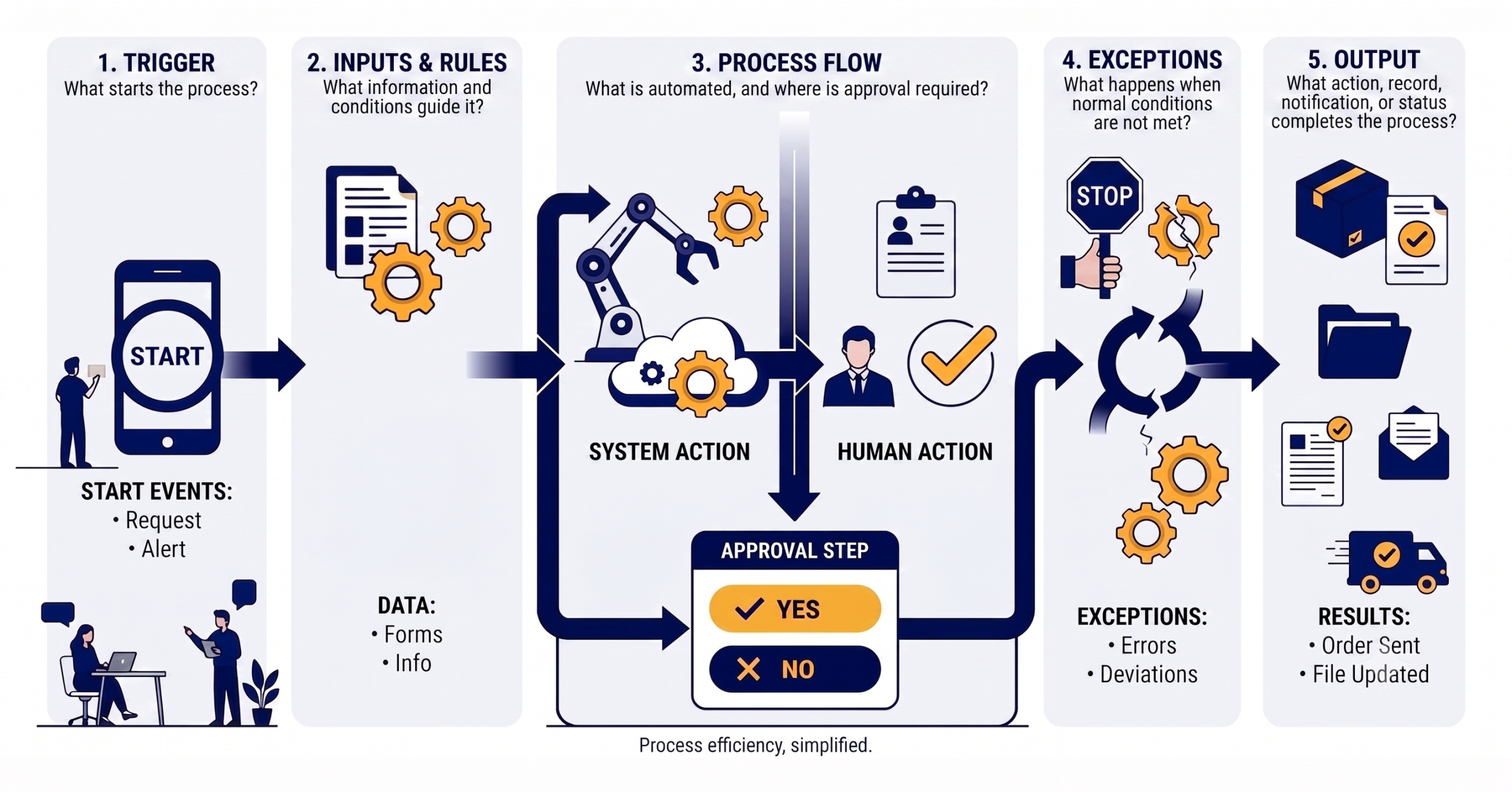
Consider load tendering. High-level requirement statements like “Automate carrier tendering” leave critical operational logic unexplained: which carriers are eligible, how rate and service history should be weighed, whether a planner must approve the recommendation, how long a carrier has to respond, or what happens after a rejection.
In practice, missing rates, rescheduled appointments, invalid documents, tracking interruptions, and disputed charges are part of daily transportation operations. If the requirements describe only the ideal sequence, teams will still end up managing the most difficult work manually.
Defining how the TMS should identify, route, and resolve these disruptions is often what separates a useful custom workflow from another layer of manual work.
What Should TMS Functional and Non-Functional Requirements Include?
Once the workflows are clear, organize the detailed requirements into four groups:
- Functional requirements: Define the expected behavior across order and load management, planning, rating, tendering, execution, visibility, documents, settlement, and reporting. ‘Provide shipment visibility,’ for instance, must specify the milestones that matter, who can see them, and what constitutes a delay.
- Users and decision authority: Identify what planners, dispatchers, carriers, finance teams, customers, and administrators can view, change, approve, or escalate. State when the system may act automatically and when human approval is required.
- Data readiness: Confirm that the information required for each workflow is available, reliable, and up to date. An ETA capability, for example, may depend on location data, time windows, milestone history, stop duration, and equipment constraints. If the inputs are incomplete, data preparation must be included in the scope.
- Non-functional requirements: Set measurable expectations for performance, scale, uptime, security, auditability, resilience, compliance, and usability, including during seasonal peaks.
- Integration requirements: Identify which external systems must exchange data with the TMS and what information each workflow requires. Detailed APIs, EDI messages, connectors, and integration models can be addressed during solution design and are covered in our TMS integration guide.
This stage should also separate standard functionality from genuinely differentiating needs. Basic order creation may not require custom tms development, but a proprietary carrier-allocation model or a customer-specific billing workflow might.
This distinction keeps the scope focused on capabilities that create operational value rather than on recreating functionality that the business can already access.
| Fill specific TMS gaps without replacing the entire platform.
Explore the Tri TMS framework |
How Should TMS Implementation Requirements Be Prioritized?
Once the full set of requirements is visible, the next challenge is deciding what to build first. A TMS MVP should deliver one or more complete, usable workflows that produce a measurable operational outcome.
Shipment booking, for example, may also require order data, carrier eligibility, tender responses, confirmation details, and exception handling. Leaving critical dependencies for a later phase could mean that the first release technically works but still requires teams to return to spreadsheets, email, or another platform to complete the process.
Teams can prioritize TMS implementation requirements using four categories:
- Must have: Required for the chosen workflow to operate safely and completely.
- Should have: Important to efficiency or user adoption, but a temporary workaround is possible.
- Could have: Valuable once the core workflow is stable and in regular use.
- Later phase: Dependent on additional data, user adoption, operational scale, or another planned capability.
Read More: Who Needs Custom TMS Workflows, What to Customize, and How to Build Them
Then turn priority requirements into testable acceptance criteria. Instead of ‘the TMS should automate carrier tendering,’ specify what makes a load ready, how the carrier is selected, what happens after rejection or no response, and when the workflow escalates. Pair technical acceptance with business measures such as manual touches, processing time, tender response, exception resolution, or user adoption.
Custom TMS Development Requirements Checklist
Before approaching a TMS development partner, prepare:
- The business problem and desired outcome
- The current and proposed workflows
- Functional capabilities and exception paths
- Users, permissions, approvals, and escalation rules
- Required data and known quality gaps
- High-level TMS integration requirements and dependencies
- Performance, security, scale, and compliance expectations
- MVP priorities and longer-term needs
- Acceptance criteria and success metrics
The document need not prescribe the architecture. A provider of custom TMS development services should help determine whether the need calls for configuration, a targeted module, modernization, or broader TMS development. But the business must define its operation, essential rules, and desired outcome.
Clear requirements create a shared basis for scoping, prioritization, and testing. More importantly, they help ensure that the resulting TMS fits the operation rather than simply reproducing a checklist of features.
Trigent helps transportation and logistics companies translate operational requirements into custom TMS workflows, integrations, and platforms. Our approach starts with the operating process, business rules, data dependencies, and measurable outcomes before defining the technology solution. By combining domain expertise in logistics with custom logistics software development capabilities, we help teams move from high-level requirements to systems designed around measurable business outcomes.
Planning a custom TMS initiative? Talk to Trigent about turning your operational requirements into a development-ready roadmap. Talk to Us.