
Think about the last 15 years when software development boomed and bloomed. Application development services thrived along with Software-as-a-Service (SaaS) applications. These applications presented a whole array of software tooling, enabling enterprises to challenge old-world inefficiencies and address untapped markets through novel solutions.
If you think about it, an entire category of enterprise operations once performed manually were automated through these applications. However, with the advent of agentic AI solutions, enterprises are poised for yet another transformative shift.
Before we understand and take stock of this transformation, it is important to be cognizant of the core difference between applications and agents.
The Shift from Applications to Agents – Explained
Applications in the pre-AI era functioned as tools designed to execute tasks ranging from simple to complex. While effective, they were inherently limited in scope, required specific programming, dependent on humans to interpret data, define workflows, and initiate actions. These applications serve as enablers, requiring human oversight to achieve desired outcomes.
With the rise of generative AI in application development, they are set to be transformed into autonomous agents, each assuming a specific personality, applying reasoning for given scenarios and capable of realizing outcomes with minimal human intervention.
The following table illustrates the difference between applications and agents and how they differ when executing a certain business operation.
| Operation | Applications | Agents |
| Organize | Applications designed to structure and categorize data using predefined rules and workflows. | Organizer agents autonomously analyze, arrange, and restructure data based on evolving business conditions, without needing human oversight. |
| Chat | Applications that were programmed to answer standard questions such as customer support chatbots | The chat agent resolves customer issues by accessing enterprise systems, updating records, and taking action without requiring human input. |
| Recommend | Recommendation applications analyze historical data and generate suggestions for improving operations. However, they rely on human users to interpret and act upon these recommendations | Recommendation agents proactively identify patterns, prioritize actions, and execute decisions.
For example, an inventory advisor agent not only identifies excess stock in one region but also suggests and initiates redistribution to high-demand areas. |
| Track | Tracking applications are tools that monitor events and log activities in real time, such as capturing anomalies or deviations.
However, their role stops at providing alerts, leaving it to humans to investigate and resolve issues |
Tracking agents act autonomously to detect deviations, identify root causes, and implement corrective measures.
For instance, a guardian agent might detect unusual login patterns, isolate affected accounts, reset credentials, and alert the security team—all in real time. |
| Predict | Predictive applications use machine learning to forecast potential challenges or opportunities based on historical data.
While they provide valuable insights, humans are responsible for interpreting the predictions and planning subsequent actions |
Predictive agents take predictions further by proactively addressing anticipated challenges.
For example, a logistics forecaster agent predicts weather-related disruptions and autonomously reschedules deliveries or reroutes vehicles to avoid delays. |
What sets Gen AI agents apart from their predecessors is the way they interact with users and systems. Unlike traditional software that relied on buttons, forms, and dashboards, these agents will use techniques such as Chain of Thought, Adaptive Reasoning or Contextual Understanding, operate independently, continuously learning and optimizing to perform their tasks efficiently.
Two Types of Human-AI Interactions
Though these agents are autonomous in nature, they will still have to be augmented by humans. Ultimately, the way the work gets done in any business will come down to two types of human-AI interactions.
1 AI-led interactions,
suited for routine, mundane processes where Gen AI agents will take the center stage executing predictable tasks with minimal human intervention. For example, in customer support, the chatbot agent’s primary purpose would not be to route questions to a human. Instead, it would solve simple to medium complex queries on its own. Novel queries would be transferred to a human agent who will largely serve in a supervisory capacity, allowing the chatbot agent to learn from previous interactions and human feedback.
2 Human-led interactions
where Gen AI agents would largely assist humans in accelerating tasks that require human creativity, ingenuity, and judgment. For example in marketing, while the writer agent would autonomously create and send emailers with low-intent prospects, high-intent prospects will be nurtured by emailers crafted by humans.
Expect Three Business Outcomes from Gen AI Agents
1 Increased Automation of Previously Neglected Tasks:
A significant number of Gen AI agents will serve processes that were long-due or previously denied for automation. These processes were earlier deprioritized or they were deemed economically infeasible to automate. However, enterprise leaders should capitalize on these low-hanging fruits, prioritizing resources and budgets to automate them effectively.
2 Avalanche of Redundant Automation:
It shouldn’t come as a surprise when most agents end up giving only a rudimentary productivity boost. 80% of Gen AI agents created in the next two years will fail to achieve the desired ROI, claims the experts. They warn that an avalanche of sub-optimal automation is on the cards.
Either these processes and their subsequent automation will only produce incremental benefits, or the processes themselves are redundant. The best way out in such a case is to reimagine these workflows for superior results.
3 Reimagined Workflows for Superior Results:
A select few Gen AI agents will challenge the status quo, going beyond simply automating existing processes to fundamentally redefining enterprise workflows. Take expense reimbursement for example. Instead of relying on an AI to extract the data from reimbursement forms, imagine a Gen AI agent that captures transaction data directly at its source—where the data is created, not where it is later recorded (forms)?
Workflow reimagination is where Agentic AI services holds tremendous potential. Enterprise leaders and ISVs alike should focus on building agents that rethink the entire process rather than merely automating steps in existing workflows.
Who Will Secure the Agentic AI Pie?
Leading software providers are already racing to build Gen AI agents capable of revolutionizing enterprise operations. Salesforce, the leader in CRM, recently launched its digital labor platform, Agentforce 2.0 within three months of launching 1.0. According to the company, their latest version is equipped to engage in context-aware interactions. ServiceNow, in association with Antropic, has embedded Gen AI agents within its Now Platform.
Apart from customer service, the Agents are making their way into core business functions. Epicor’s ERP agents serve its manufacturing-heavy user base, who are searching for actions rather than mere answers. For example, the AI agent can flag a particular item and request the floor manager to prioritize shipping the item since the customer is willing to pay a premium if the order is delivered sooner.
Software providers are thus actively building their Gen AI agents wanting to have a go at the total addressable market (TAM) believed to be in trillions of dollars. These third party agents will take over highly repeatable job-to-be-done services spanning customer support, bookkeeping, financial reporting, cloud migration, application support, and penetration testing.
Read the Report: Trigent Software Recognized as a Leader in Generative AI Services by ISG.
Will Enterprises Adopt Third-party Agents or Build their Own Gen AI Agents?
Trigent predicts that 2025 and subsequent years will witness a significant number of enterprises opting for readily available third-party agents that have been tested and refined by thousands of users. However, a good proportion will prefer to use these agents through AI wrappers to ensure data anonymity. AI wrappers preprocess, anonymize, and even add custom logic to data before sharing with third-party agents.
For example, a healthcare organization might use a third-party summarization agent to generate patient summaries. However, considering regulations such as HIPAA, it would use an AI-wrapper to anonymize patient data before sending it to an external service. Additionally, the AI-wrapper may preprocess the data (structuring medical notes) and even add custom logic such as tagging critical conditions so that the summarization agent can emphasize these conditions when generating the summary.
When would custom agents be preferred?
The same motivations that pushed enterprises to build their custom applications will again encourage them to build their own Gen AI agents:
- Absence of a niche agent in the market that caters to their unique need.
- Fear of losing their proprietary data to third parties
- Desire to leverage their IP and build a custom agent that gives them superior competitive advantages.
It is important to note that when building custom agents, computational expenses may cause concern as there is a good chance that costs may spiral out of control unless sufficient guardrails are in place. Hence it will be highly likely that enterprises may opt for small language models instead of LLM, one that is cost-effective but at the same time ensures the same level of output accuracy as found in large language models.
Conceiving Agents: 3 Ways to Code and Develop Gen AI Agents
It would be interesting to see which tools software engineers will use to code and develop Gen AI agents. Either they would resort to Gen AI assistants such as Amazon Q, Cursor or CoPilot, or they would try autonomous coding agents such as the Devin. While the former acts as intelligent code editors with autocomplete features, the latter could prove useful in writing entire code blocks, functions and even for complex custom application developments. Meanwhile, developers will also be encouraged to use established low-code tools such as Mendix and Power Automate that are increasingly augmenting their platforms with gen-ai capabilities.
Read Trigent’s detailed review on impact of Gen AI assistants in Software development.
A comparative analysis of the above tools should give a more clear picture.
| Feature | Gen AI assistants (Amazon Q, CoPilot, ChatGPT) | Coding Agents (Devin) | Gen-AI powered low-code platforms (Maia, Power Automate) |
| Autonomy-control trade-off | Minimal autonomy; high control. Developers remain at the center, with the assistant providing suggestions for code completion and pattern replication | High autonomy; moderate control. Agents act more independently, performing tasks asynchronously, leaving developers in a reviewer role | Moderate autonomy; user-driven control. Low-code tools combine visual development with AI, enabling users to create workflows with hands-on control |
| Contextual Awareness | Limited. Retains context for immediate tasks but struggles with cross-module or complex scenarios | Strong. Maintains context across broader projects, adapting better to dynamic workflows and multi-module interactions | Moderate. Works well within the defined platform constraints but lacks deep, cross-platform contextual understanding |
| Use-Cases | Simple to medium-complexity tasks. Ideal for repetitive code generation, application support, or system upkeep | Complex workflows and applications. Suited for large-scale, multi-framework projects requiring automation and proactive task execution. | Democratizing development. Best for enabling non-technical users to build applications or workflows, especially in enterprise settings. |
| Productivity advantages | Boosts individual productivity. Accelerates code writing and overcomes coder’s block, reducing development time for simpler tasks | Transforms team productivity. Automates significant portions of coding, freeing developers to focus on high-level design and review. | Empowers wider teams. Allows business users and non-technical contributors to develop applications without needing coding expertise |
| Risks and Demerits | Debugging inefficiencies. Generated code often requires refinement, and bugs can negate speed gains. Limited for complex, novel scenarios | Loss of control. Autonomous agents may introduce errors that are harder to debug and can pose risks in novel or edge cases. | Obsolescence risk. As Gen AI tools assistants and agents evolve, low-code platforms may face competition, especially for advanced, technical workflows. |
The Rise of Agentic AI
If enterprises were to increasingly adopt Gen AI agents, wouldn’t we, sooner or later, witness a network of enterprise agents communicating with each other and executing business actions at unimaginable speeds?
The Agentic AI platform, one that constitutes a network of Gen AI agents, will undoubtedly create a profound shift. Because, unlike the application era, the agentic era extends beyond mere automation of processes, simple or otherwise. Agentic AI for enterprise ventures into the realm of autonomous decision-making; those decisions, tactical or otherwise, that were once entirely dependent on humans, will also go autopilot.
Could Agentic AI usher in the era of the autonomous enterprise?
This evolution could be the start of an autonomous enterprise, one that dynamically learns, optimizes, and seamlessly executes actions, while being continuously enriched by human creativity and strategic oversight.
To put things in perspective, consider the case of a logistics company leveraging an Agentic AI platform. Within its ecosystem, a route optimizer agent calculates the most efficient delivery routes and adjusts plans in response to disruptions; a demand forecaster agent predicts delivery demands using historical data and seasonal trends; an inventory management agent monitors stock levels, triggering restocking processes autonomously; a tracking agent ensures real-time package monitoring and customer notifications; and a fleet management agent oversees vehicle health and fuel efficiency. At the helm of this ecosystem is an orchestrator agent, a supervisory AI ensuring that all agents operate in unison, coordinating their efforts to achieve overarching business objectives.

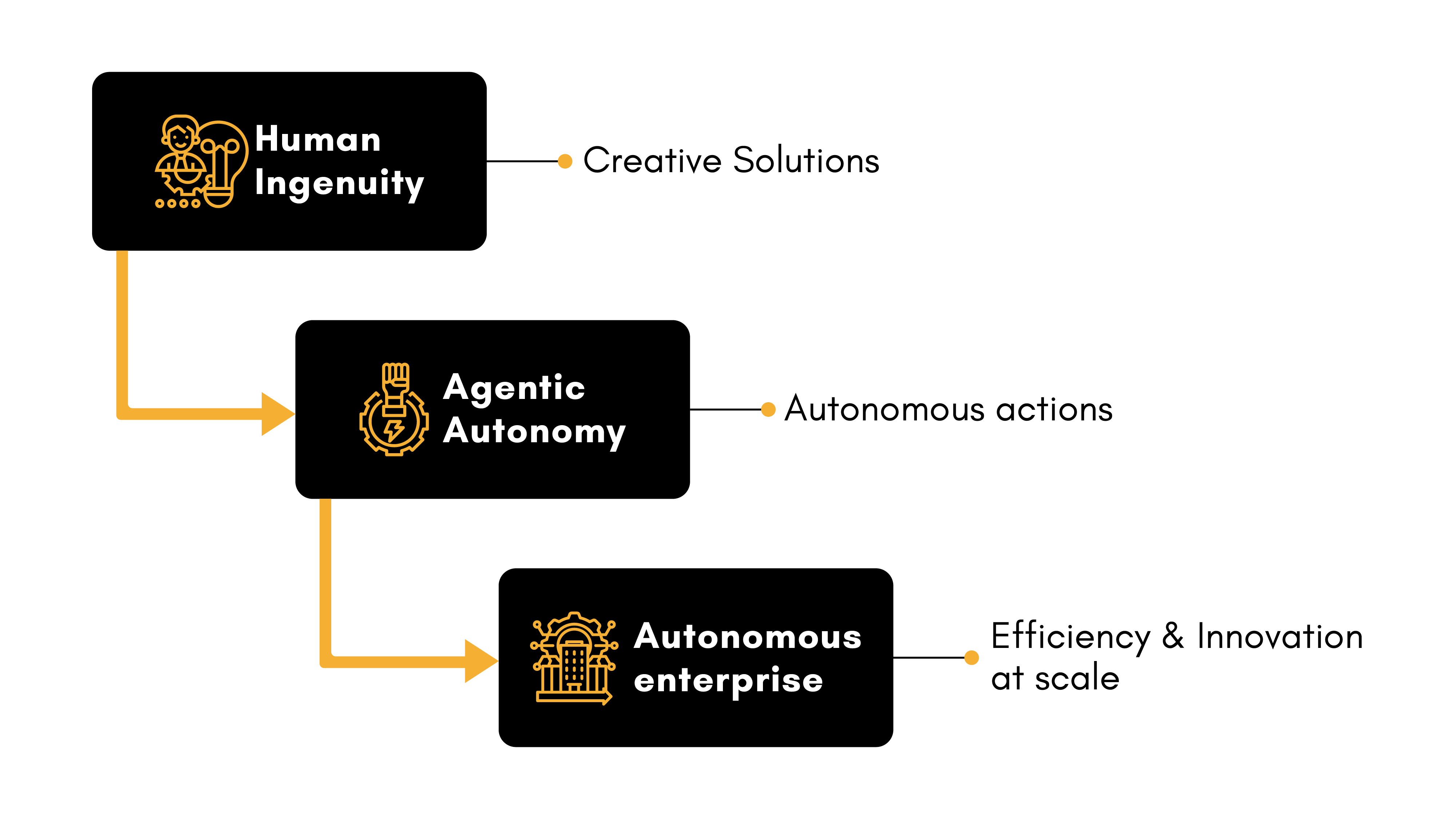
While human agents remain integral, their roles evolve to overseeing escalations, managing exceptions, and infusing creativity into strategy. This synergy between human ingenuity and agentic autonomy will redefine the enterprise landscape delivering unprecedented efficiency, adaptability, and innovation at scale.
Building Agentic AI – You Need a Partner who Knows the Game
Trigent was recently recognized as a leader in Generative AI services. Our team of experts believe that no later than the turn of the next decade, organizations will begin to conduct their operations through the Agentic AI platform. How will the Agentic AI platform connect to existing business systems? This is where Trigent comes into the picture. With deep expertise in AI and Gen AI, we help companies create, optimize and sustain their data and AI layer. With time-tested and homegrown frameworks, we help you architect the enterprise orchestration layer, one that serves as a vital nexus between Agentic AI and internal systems.
The Future Ahead
2025 will undoubtedly be a pivotal point when enterprises and ISVs collectively embrace AI in software development for ISVs. However a little note from Bill Gates in his 1996 book “The Road Ahead” rings a bell. “We always overestimate the change that will occur in the next two years and underestimate the change that will occur in the next ten”.
