Integration in a TMS context covers a wide range of technical arrangements, and the word alone tells you almost nothing about how much manual work survives underneath it. A live API, a nightly file transfer, and a full order-to-cash handoff across six systems are all referred to as “integrated” in vendor conversations, though only one of them eliminates rekeying from the process.
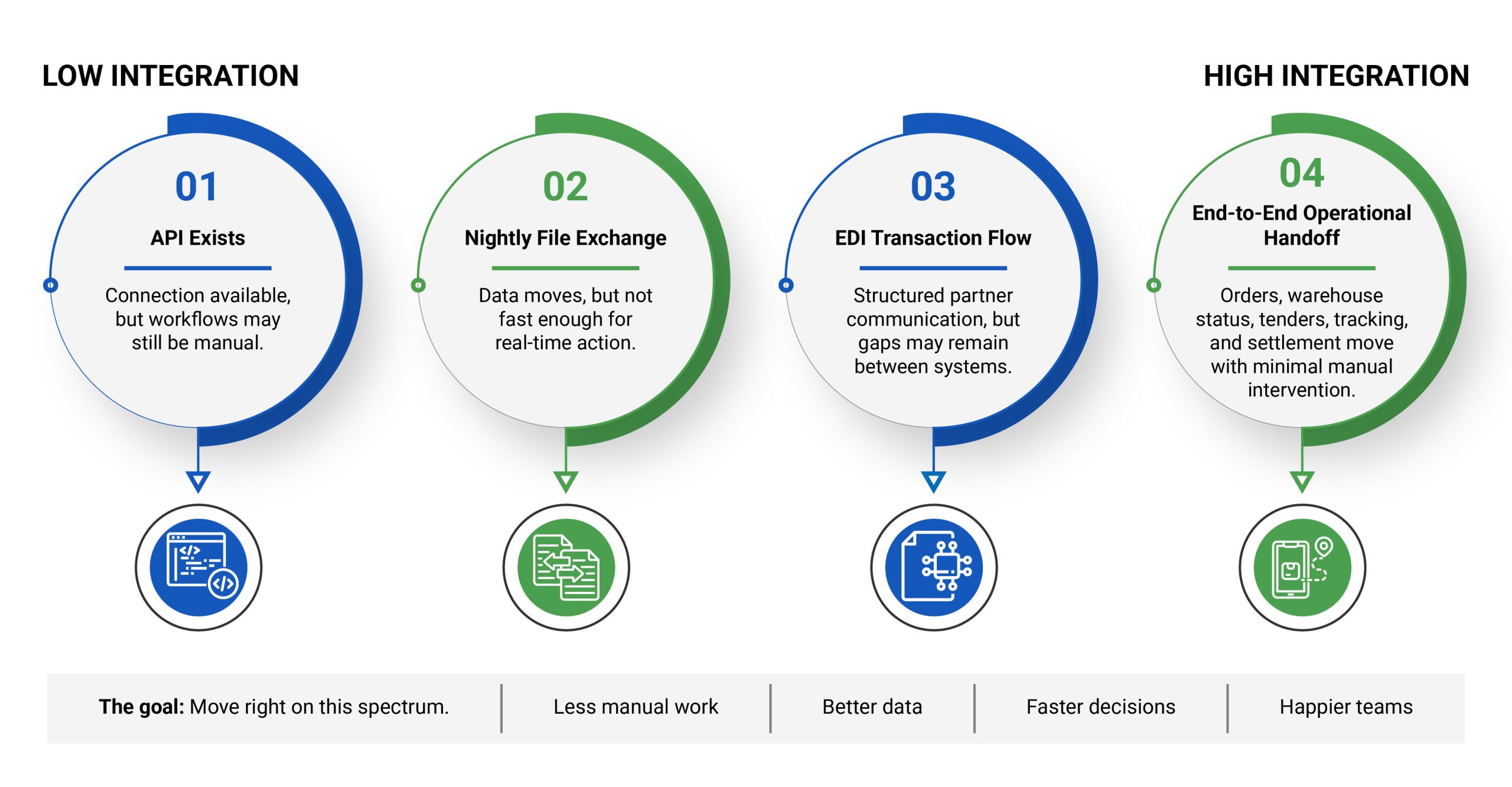 The practical test for transportation teams is determining whether information moves fast, accurately, and with enough context for the next system or person to act on it. A supply chain technology provider offering both transportation and warehouse management solutions notes that when these systems operate separately, orders often require manual intervention. Connecting them allows transportation activities to respond to warehouse updates in real time.
Why You Should Start with the Handoffs
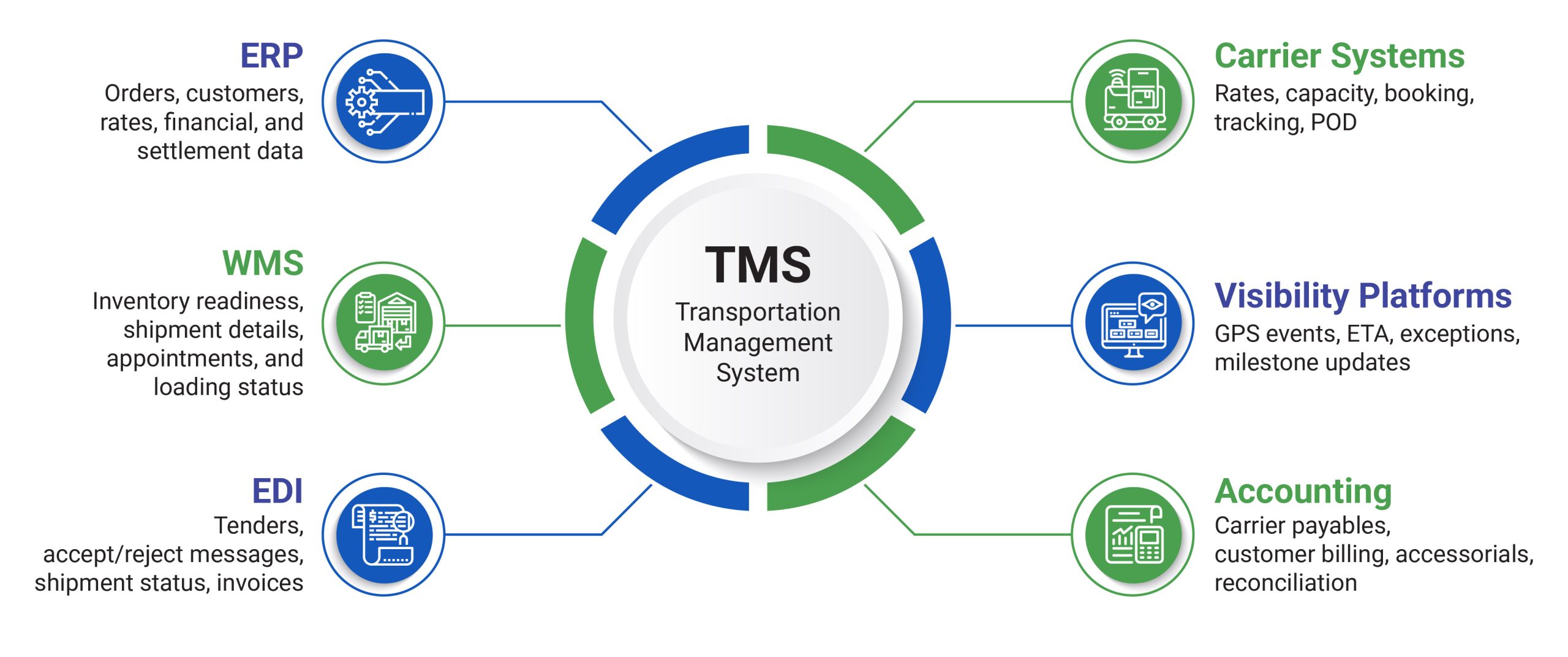
A modern TMS cannot work in isolation. It needs order and customer data from an ERP, inventory and pick status from a WMS, tenders and shipment updates through EDI, GPS events from telematics, live carrier rates, appointment information, proof of delivery, and invoice data.
The integration question is therefore about what happens at each touchpoint and how it flows.
Take, for instance, a distributor operating from New York. The ERP creates a customer order, while the WMS confirms inventory, picking, loading, and dock readiness. The TMS uses those signals to plan and tender the shipment. The carrier responds via EDI or an API; telematics provides location data; and a visibility platform turns milestones into customer-facing ETAs. Finance eventually needs the shipment, rate, accessorial, proof-of-delivery, and invoice data for settlement.
Each handoff raises practical questions:
- Which system owns the shipment date, address, carrier code, and freight cost?
- Does the TMS receive a pick-complete event immediately or through a batch file?
- Can a carrier rejection automatically trigger a new tender?
- What happens when the carrier’s status conflicts with the visibility platform?
- Can finance reconcile the invoice against the approved rate and proof of delivery?
A technically valid message can still create operational trouble when field definitions, timing, or ownership remain unclear. So WMS-TMS integration becomes critical for connecting warehouse readiness with transportation planning and reducing manual processing.
What Should a TMS Integrate with?
Oracle, McLeod, and MercuryGate take different approaches to this problem. Oracle Transportation Management treats integration primarily as infrastructure: data moves via a REST API and a set of XML transaction schemas, and Oracle Integration Cloud provides prebuilt process flows to connect OTM to ERP and warehouse systems. That gives buyers a flexible foundation, though most still need an integration partner to build the connective tissue for a specific ERP instance or a legacy system such as AS400.
McLeod leans on a certified partner ecosystem of more than 140 vendors covering telematics, load boards, and accounting, so many carrier and fleet integrations arrive largely pre-built. That works well until a company needs a workflow outside McLeod’s partner list.
MercuryGate, now part of Infios, supports integration through a combination of platform capabilities and third-party connections. In one Redwood Logistics implementation, Opendock was integrated with MercuryGate in two weeks, automating dock appointments and centralizing operational data. This shows how integration speed can vary significantly depending on the platform, partner ecosystem, and scope of the connection.
The real question is whether a platform’s integration model, API-first, partner-marketplace, or hybrid, matches the systems already running in the business.
When Standard Connectors are Enough, and When Custom Development Enters
Standard connectors handle the common cases well: mainstream ERPs, major carriers, conventional order-to-cash workflows, and vendor-certified partners. Custom development becomes necessary when a business runs multiple ERP instances from acquisitions, depends on legacy systems like AS400 that predate modern APIs, needs customer-specific validation rules, or has exception logic that must weigh data from multiple sources before deciding what happens next. A tender with different accessorial rules for three customer contracts is not something a standard connector was built to handle.
Trigent’s Tri TMS model is especially useful in this context, as it does not assume that the answer is a full TMS replacement. Companies can add a targeted capability, integrate a new component with the existing transportation stack, progressively replace legacy functions, or use reusable building blocks as the foundation for a broader custom TMS. The model is designed around the idea that the integration gap may be only one part of the system, not evidence that the whole platform needs to go.
That modular approach becomes especially valuable when the core TMS works, but its carrier integration layer cannot accommodate the variety of systems, formats, and workflows surrounding it. In one such engagement, Trigent helped a cloud-based multimodal TMS provider connect carrier partners that used different systems, web services, and definitions for the same data fields. Rather than replacing the existing platform, Trigent strengthened the layer around it by integrating more than 100 logistics companies into a single platform and developing over 250 custom APIs. The resulting solution supported end-to-end workflows spanning rate requests, booking, cancellations, BOL and POD retrieval, invoicing, transit times, and shipment tracking, with rigorous testing before production.
| See the Tri TMS building blocks and modernization options |
Build Around the Integration Gap, Instead of the Vendor Logo
This is where the argument about custom TMS workflows becomes practical.
A company may already have Oracle TMS, McLeod, MercuryGate, or another commercial platform and still need a custom layer around carrier onboarding, document processing, ERP integration, billing, visibility, or customer experience. If the core execution engine remains reliable, replacing the entire TMS may create more disruption than value.
The same principle applies when acquisitions leave a company with overlapping transportation platforms. In one post-M&A modernization engagement, a TMS provider was operating two platforms with separate integration layers, duplicated carrier connections, and redundant third-party data subscriptions. Trigent developed a unified API gateway across both platforms, consolidating rate quoting, shipment booking, tracking, and document retrieval without requiring either TMS to be immediately replaced. The solution reduced duplicated integration costs, streamlined external connectivity, and created a scalable foundation for future modernization.
When Should You Outsource TMS Integration or Development?
The strongest reason to outsource TMS development is usually not a shortage of developers. It is the need for a team that understands both transportation workflows and the integration architecture underneath them.
A useful partner should be able to discuss EDI 204, 214, and 210 flows, REST APIs, retry logic, master data conflicts, carrier onboarding, billing dependencies, and operational exceptions in a single conversation.
Trigent’s logistics software development services span those layers: integration, custom software development, modernization, QA, cloud, data, and AI-assisted workflows. That depth makes the conversation less about adding engineering capacity and more about deciding which part of the transportation stack should actually change.
| Discuss your TMS integration architecture with Trigent |
| Schedule a consultation |